

In this week’s Torah portion, Hayyei Sarah, Avraham sends his servant Eliezer to find a wife for Isaac. And Eliezer says, God, help me out: could You make it so that whichever woman offers to help me get water not only for myself but also for my camels, that woman is the one You’ve intended for my master’s son?










Constancy & Change, the Torah & the Sky: Shabbat Hayyei Sarah 5786
Contemplative Practice, Divrei Torah, From The RabbiIn this week’s Torah portion, Hayyei Sarah, Avraham sends his servant Eliezer to find a wife for Isaac. And Eliezer says, God, help me out: could You make it so that whichever woman offers to help me get water not only for myself but also for my camels, that woman is the one You’ve intended for my master’s son?
From the Rabbi – November 2025
Cheshvan, Days of Awe, Events, From The Rabbi, Jewish Holidays, Newsletter, Shabbat, Spiritual LifeAs I write these words we’ve entered the lunar month of Heshvan, during which there are no holidays other than Shabbat. After the densely-packed spiritual season of the high holidays, Heshvan can feel like an abrupt gearshift.
November 2025 | Cheshvan / Kislev 5786
Community, Days of Awe, Events, From The President, Jewish Holidays, NewsletterWe hope you enjoyed a beautiful high holiday observance. We were delighted to welcome many of you into our overflowing sanctuary to worship together, share special holiday treats on Rosh Hashana, break-the-fast on Yom Kippur, and enjoy a community potluck in our beautiful sukkah.
From the Rabbi – October 2025
Cheshvan, Days of Awe, From The Rabbi, Jewish Holidays, Newsletter, Sukkot, Tishrei, Yom KippurWhat a beautiful holiday season it has been thus far. It was such a joy to be with you on Rosh Hashanah and during the first half of Yom Kippur!
As you may know by now, I experienced several TIAs during Yom Kippur morning services. (It was difficult for me to speak at times, and the words either wouldn’t come out, or came out wrong.) Thankfully each episode passed quickly and I was able to continue praying with you through the end of Yizkor. After that I went to the hospital for the remainder of Thursday and all of Friday. I am now released from the hospital and recovering at home comfortably.
October 2025 | Tishrei / Cheshvan 5786
Cheshvan, Community, Days of Awe, Events, From The President, Jewish Holidays, Newsletter, Rosh Hashanah, Spiritual Life, Tishrei, Volunteering, Yom KippurThis month’s column is a reprint of this year’s Days of Awe co-presidential speeches that were delivered on Rosh Hashanah I & Yom Kippur.
Noticing, in the Now: Yom Kippur 5786
Days of Awe, Divrei Torah, From The Rabbi, Sermons, Yom KippurSeveral of you asked me: “Could you talk at the high holidays about how we can stay sane? How can we pay enough attention to be connected, but not so much it harms us?”
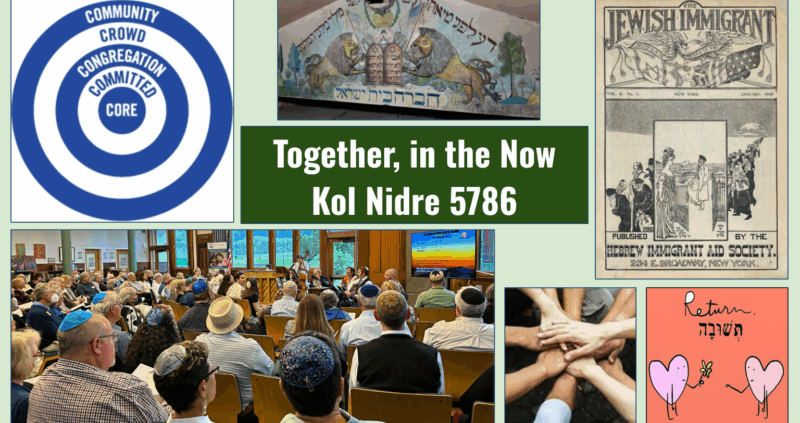
Together, in the Now: Kol Nidre 5786
Days of Awe, Divrei Torah, From The Rabbi, Sermons, Yom KippurThe first known Black mutual aid society was the African Union Society, formed in Newport, Rhode Island in 1780. Seven years later, African Americans in Philadelphia formed the Free African Society to provide benefits to the needy, aid for the ill and unemployed, and burial assistance. By 1838 there were a hundred of these societies in Philadelphia alone. After the civil war, free Black Americans started credit unions when White-owned banks wouldn’t serve them. They pooled resources to buy farms and land, to care for widows and children, and to bury their dead. I’m not sure if my ancestors knew they were following in those footsteps when, in the late 19th and early 20th centuries, Eastern European Jewish immigrants formed landsmenschaftn, mutual aid societies rooted in shared geographic origins.
Hope, in the Now: Rosh Hashanah I 5786
Days of Awe, Divrei Torah, From The Rabbi, Rosh Hashanah, SermonsThis is the hardest sermon I have ever tried to write.
My fear this morning is that when I say something that’s hard to hear, you might stop listening or close your heart to what I’m trying to say.
So here is my ask of you this morning. Take a deep breath. Let it out. Maybe do it again a few times. And please make a conscious effort to hold certainties lightly and to keep your heart open.
In the Now: Erev Rosh Hashanah 5786
Days of Awe, Divrei Torah, From The Rabbi, Rosh Hashanah, SermonsA while ago I went looking for a New Yorker cartoon. I don’t subscribe to the magazine these days – I used to, maybe ten years ago, but they arrived more quickly than I could read them. After a while the stack of un-read issues made me feel like I was falling down on the job of being a well-informed poet! Still, many of the illustrations are available online, so I went hunting. I knew exactly what the cartoon looked like. And I couldn’t find it. No one else could seem to find it, either. Maybe it didn’t exist.
From the Rabbi – September 2025
Days of Awe, Elul, Events, From The Rabbi, Jewish Holidays, Newsletter, Rosh Hashanah, Runway to the Days of Awe, Tishrei, Yom KippurEvery year, I try hard to find the right balance in high holiday planning. Some things are the same every year, and they should be! High holiday nusah (the melody-system associated uniquely with this season) and familiar melodies are a spiritual touchstone. They reach us in our hearts. They are a musical carrier-wave that can bring us to our deepest selves. And some things are different every year, and they should be!
September 2025 | Elul 5785 / Tishrei 5786
Community, Days of Awe, Events, From The President, Jewish Holidays, Newsletter, Sukkot, Volunteering, Yom KippurWe send warm greetings to the CBI community as we enter this sacred season of the High Holy Days. Our devoted rabbis and choir have been working with care to ensure that our services are both meaningful and uplifting, and we look forward to gathering with you to worship and for our community Break-the-Fast.
From the Rabbi – August 2025
Av, Events, From The Rabbi, Newsletter, Runway to the Days of Awe, Spiritual Life, Tisha B'AvThe choir is rehearsing high holiday melodies. My teen has begun attending his final summer camp of the season. The roads are lined with blue chicory blooms and frothy Queen Anne’s Lace. I’m about to start eating corn and tomatoes at every meal I can, because there’s nothing like sweet corn in season or a tomato ripe off the vine. And now that we’ve made it through Tisha b’Av, we’re on the spiritual upswing toward Rosh Hashanah! Happy August.
August 2025 | Av 5785
Community, Events, From The President, Newsletter, VolunteeringThe summer is zipping by, as it always seems to do. We hope you are enjoying all that the Berkshires have to offer. Our rabbis and lay leaders have been busy planning for the upcoming year and have some exciting ideas for the coming year.
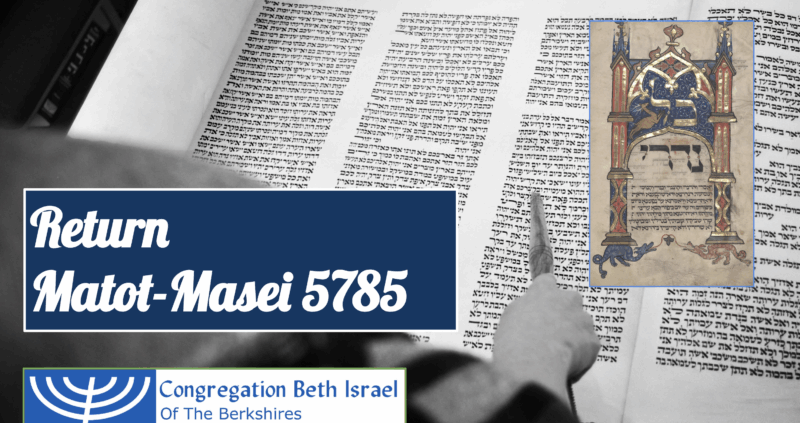
Return: Matot-Masei 5785
Divrei Torah, From The Rabbi, Israel, Response to Tragedy, Spiritual LifeIt never fails: we reach this Torah portion, Matot-Masei, in high summer and I go, “Wait, what? Already?” The words in this single verse are like hyperlinks. נֶדֶר, vow. שְׁבֻעָה, oath. כָּל נִדְרֵי וֶאֱסָרֵי וַחֲרָמֵי, וְקוֹנָמֵי וְכִנּוּיֵי, וְקִנּוּסֵי וּשְׁבוּעוֹת… Surprise! It’s a reminder of Kol Nidrei.
From the Rabbi – July 2025
From The Rabbi, Newsletter, ShabbatIn recent weeks, I’ve been paying visits to someone in a skilled nursing facility who has a copy of this very Rosie the Riveter “We Can Do It!” poster propped up in the room. I think it’s an excellent reminder that even when life’s challenges might seem insurmountable (and even when simple physical tasks might feel insurmountable), we can persevere… especially if we focus on what we can do, instead of what we can’t.