I know this hasn’t been an easy year.
I know this year has often felt like walking a balance beam that mysteriously got narrower when we weren’t looking. Or maybe even like walking a balance beam while unknown forces are throwing things at us. Softballs. Strong winds that change direction without warning. Occasionally rocks.
I know it’s been hard to stay upright with global politics so destabilized (and destabilizing). War with Iran, that was new this year. War in Ukraine, tragically old hat. The Middle East simmering like an angry teapot, always painful.
I know it’s been hard to stay upright with national politics so destabilized (and destabilizing). When it feels like truth itself has been under assault – like this summer, when the order came down for the Smithsonian to put up signage disclaiming the truths in its own exhibits, as though our patriotism weren’t strong enough to withstand our actual history.
When it feels like the planet herself has been under assault – between increased production of oil and coal, and AI data centers booming though we know we’re running out of groundwater.
When it feels like science has been under assault – as measles returns, and political appointees with no science background are increasingly given control over what science to fund.
When it feels like democracy has been under assault – with [a]ttempts to seize election powers and manufactured election distrust creating chaos already, and none of us certain what November will bring.
I know it’s been hard to stay upright in a time of anxiety about antisemitism. I don’t even want to mention the attacks on synagogues in the last year, though I imagine most of us can list them. It’s enough, maybe, to acknowledge that we feel each of them in our hearts and in our bones. The Jewish world is interconnected and small.
I know it’s been hard to stay upright in a time of rising Christian nationalism. Earlier this year, the Public Religion Research Institute published a report “showing that nearly a third of Americans [now] qualify as Christian nationalist adherents or sympathizers.” It’s hard to watch the nation we have always called home becoming less welcoming not only to us as Jews, but to the multicultural values we hold dear.
I know it’s been hard to stay upright in a time when strife among Jews feels higher than ever before. It feels like those of us who are Zionists, and those of us who are non-Zionists, are becoming increasingly unable to hear one another or to tolerate one another’s presence. That makes it increasingly hard to be, or stay, in community – at a time when I believe we need each other more than ever.
I know it’s been hard to stay upright when corruption festers and injustice is allowed to persist. And then there are the personal things that might have thrown us for a loop this year. A yearned-for promotion going to someone who doesn’t deserve it. A death, a divorce, a lost job. A loved one getting sick who isn’t going to get well…
I can’t fix any of these things. Nothing I say this morning will make them stop being true. And I really struggled with that this year. Because I care about you, deeply. I want you to flourish and thrive. And it feels like so much about our world right now prevents us from thriving.
The key words there are “feels like.” As I learned from a therapist friend, “feelings are not facts.” All of the news stories I just mentioned are real, and the feelings of precarity they generate are real. And… these feelings are only part of the story.
In her essay In The Dark Times Will There Also Be Singing, Rebecca Solnit asks:
That question was on my mind this summer as I went on the third of four retreats in the Clergy Leadership Program at the Institute for Jewish Spirituality. The retreats are tech-free – which means no one is multitasking, checking Facebook every ten seconds, or being buffeted by the slings and arrows of the news. I am amazed every time by how much of a difference it makes for me to put down my phone and opt out of the outrage cycle. Of course, putting aside our tech is part of traditional Shabbat and holiday practice for many Jews. But I struggle to do it. Maybe you do too.
When we get caught in the digital outrage cycle, who benefits? Arguably, the news and social media companies who capture our eyeballs and our spirits. Which raises for me the question: is that where we want this life’s energy to go?
My teachers at IJS invite us to slow down and notice when and why we feel buffeted. Along with that noticing, we can cultivate a sense of curiosity about what we’re feeling and why. We can pull back enough to be able to name the feelings, because that can give us just the tiniest bit of spaciousness… and that can give us the capacity to choose how we respond.
Because even in rough times, when we can’t choose what cards we’re dealt, we can choose how we respond to that hand. In the words of Dr. Victor Frankl:
The goal isn’t to stop feeling our feelings, God forbid. The goal is to learn how to maintain just a bit of space between the match and the flame, between the thing that’s happening and our reactivity. That’s part of the spiritual quality of balance.
We strengthen our balance when we remember that crisis isn’t all there is.
There is love in the world. My love for you; my love for my child; my love for my ancestors; my love for community. All of those are different. Maybe there are as many kinds of love as there are relationships. It is a cliché to say that love is a reason to savor being alive. But that doesn’t make it any less true.
There is Shabbat: in her very nature an antidote to the grief-and-grind of the news week and work week. Remember, or imagine, the scent of the air right after lighting candles and blowing out the match. The little twin lights – maybe they represent the light of creation and the light of Sinai, and maybe they’re just tiny little fires gleaming in the darkness. They don’t last, but they will always return.
![[L to R]: Two lit shabbat candles; a beautiful sunset sky; a rosemary plant.](https://cbiberkshires.com/wp-content/uploads/2026/09/RH-1-2026-RB-04.png)
There is the sight of the sky streaked with changing color over the everlasting hills. The waxing and waning moon. The scent of rosemary rubbed between our fingers, or the scent of a fresh orange when a nail rips into the peel. The way it feels to sing with other human beings and feel one’s voice slot into the chord.
Even these small beauties can help us keep our balance. Here’s Rebecca Solnit again, in that same essay:
The way the shadow of the tree reaches out like a hand to hold me just after sunrise, and magpies fly into last summer light so thick and golden they looked like arrows shot into honey … Those [small] experiences anchor and reinforce us so that we can go back to address the large ones, the troubles and dangers of the political realm.
Turning to beauty should never become a way of avoiding reality or abdicating our responsibility to help others. But making a practice of noticing and savoring beauty can be a way of strengthening ourselves for the journey ahead. A way of keeping balance.
In that space of balance we recognize that despair isn’t wisdom. I was reminded of this by a YouTuber named John Green. He’s an author, he’s part of the duo known as the Vlogbrothers, he’s a divinity school dropout (so of course I like him). And there’s a clip from one of his videos that I hope you’ll watch when you get this in your email inboxes: a five-minute video about how despair is not wisdom.
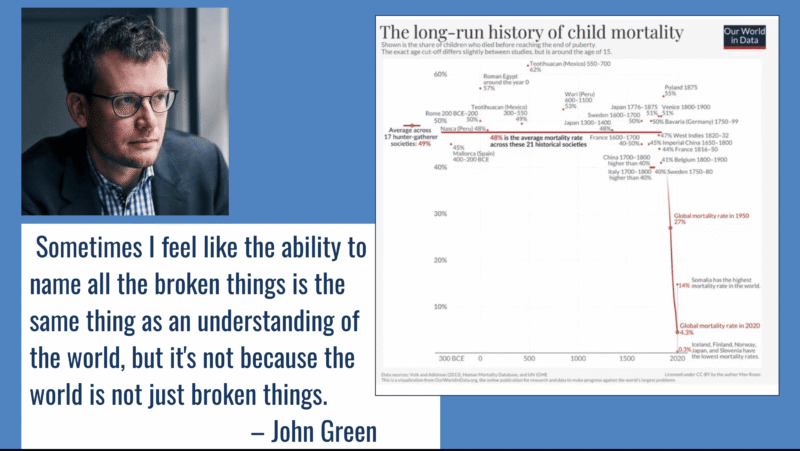
He begins by showing a graph of infant mortality over the last 2300 years, from this article. And he notes that when he first posted this data, a ton of people showed up to tell him why it doesn’t matter.
It is so hard to hear that something has gone right without immediately pointing out all of the things that are going wrong. And there are good reasons for this. There are people who use progress as a sedative. They’ll say, “Look how far we’ve come.” What they mean is please stop asking for more. But that’s not what this graph says to me. It says the opposite.
I see this graph with a trajectory that is not finished. It is not a graph that says everything is fine. It is a graph that says despair is not wisdom. Sometimes I feel like the ability to name all the broken things is the same thing as an understanding of the world, but it’s not because the world is not just broken things. And I don’t want to live in a mind where every piece of good news has to be immediately escorted out of the room by a committee of caveats.
I recognize myself in the doomerism that John Green describes. I saw the graph of decreased infant mortality, and I thought: yeah, but in the last eighteen months our government has gutted the Centers for Disease Control the same way it gutted the United States Agency for International Development. Lurching to find a way to respond to positive news with grief: if that’s not out of balance I don’t know what is.
Despair is not wisdom. In fact, in the words of Hasidic master Reb Nachman of Breslov, אסור להתייאש assur la-hitya’esh: despair is forbidden. We’re allowed to grieve. (God knows we’ve had what to grieve.) But we’re not supposed to despair. Because despair implies that we don’t think it will ever get any better. And in the traditional understanding, that’s an insult to God. This is where I note, as I always try to do, that if the “G-word” doesn’t speak to you this is an invitation to find a source of meaning that does. Justice, Love, Hope, the Sacred, the Cosmos – try them all on until you find one that fits.
There’s a deep wisdom hidden in the Hebrew. להתייאש / l’hitya’esh is a reflexive verb, something we do on, in, or to ourselves. Like “I dress myself,” or “I remind myself.” Despair is something we do to ourselves. Reb Nachman, who was known to suffer from depression, says point blank: don’t fall into that trap.
When we fall out of balance and “despair-ourselves,” we’re acting as though we know that nothing will ever get better. We do not actually know that. Beyond that, whether things get better may depend in large part on whether or not we give up.
It’s not easy to hold both our smallness (the world’s problems are so vast, what can we really change) and our vastness (to save one life, maybe even just to impact one life, can be to save an entire world).
Balance requires strengthening our ability to hold on to seemingly contradictory truths. Tragedy is real, and joy is real, and neither one cancels out the other. That’s why this year’s little high holiday take-home gift is one of Steve Silbert’s Finding Balance cards.
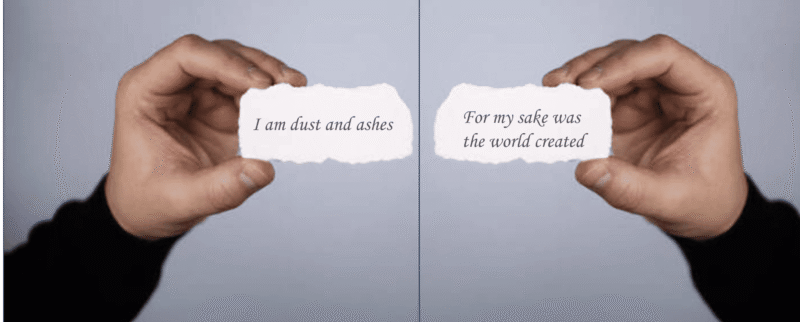
They evoke the story of R. Simcha Bunim who kept two slips of paper in his pockets, one that said “for my sake was the world created” and another that said “I am dust and ashes.” Each of those feelings is a corrective to the other. We need both.
The poet Wendell Berry, who died just a few weeks ago at the age of 92, wrote:
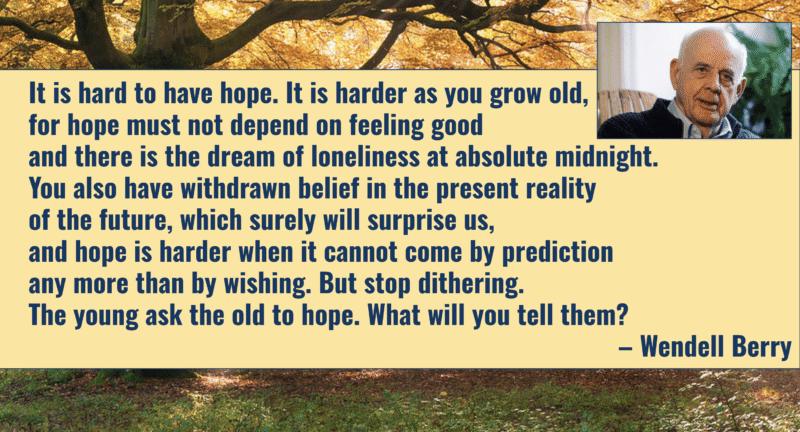
For an answer, I turn to R. Jonathan Sacks, the former chief rabbi of Great Britain. R. Sacks wrote a lot about linear time and covenantal time.
Linear time is exactly what it sounds like: we move from past toward future, and progress just happens (or doesn’t). Covenantal time says: history isn’t over yet, and it’s our job to partner with God or with one another to work toward a more moral world, a world of equity and justice, a world redeemed.
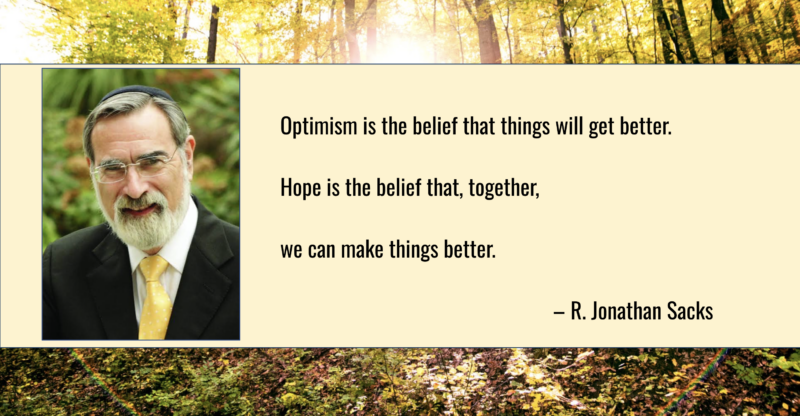
The deepest difference between linear and covenantal time is that whereas the first gives rise to optimism, the latter leads to hope. These two concepts, often confused, are in fact utterly different. Optimism is the belief that things will get better. Hope is the belief that, together, we can make things better. Optimism is a passive virtue, hope an active one. It takes no courage – only a certain naivety – to be an optimist. It takes great courage to sustain hope. No Jew – knowing what we do of the past, of hatred, bloodshed, persecution in the name of God, suppression of human rights in the name of freedom – can be an optimist. But Jews have never given up hope. (– The Jonathan Sacks Haggadah p. 102)
The best tool I know for cultivating balance is seeking to live, as R. Sacks suggests, in covenantal time. In covenantal time we recognize the brokenness of now – and claim our agency and power to partner in repairing whatever brokenness we can. The antidote to despair is action. And while despair is isolating, action is something we can do together. We can strengthen community. We can help one another thrive.
We know what our world has been, and what it is now. What it may yet become is – at least in part – up to us.
This is the sermon that Rabbi Rachel Barenblat offered during Rosh Hashanah I 5787 morning service on Saturday, September 12, 2026.