When I moved here from Texas 34 years ago and realized how much the daylight shifts from summer to winter and back again, I started really paying attention to the solstices and equinoxes. The solstices are the longest and shortest days of the year. The equinoxes are the midpoints in-between.
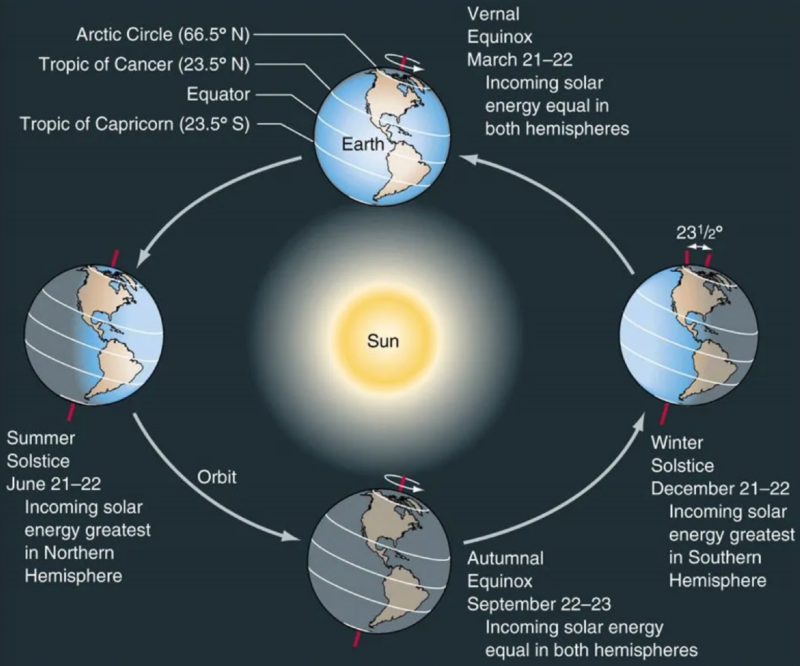
It’s possible I like the equinoxes because my birthday is March 21. It turns out the actual astronomical moment of equinox is variable. Sometimes the spring one is on the 20th, sometimes the fall one is on the 22nd… But personally I mark each equinox on the 21st.
It’s erev September 21. Happy autumn equinox, friends. We are equally far from the longest day of the year back in late June, and the shortest day of the year in late December. Today the seasons hang in the balance. That feels appropriate for the day when, tradition teaches, our lives and our souls hang in the balance. Welcome to Yom Kippur.
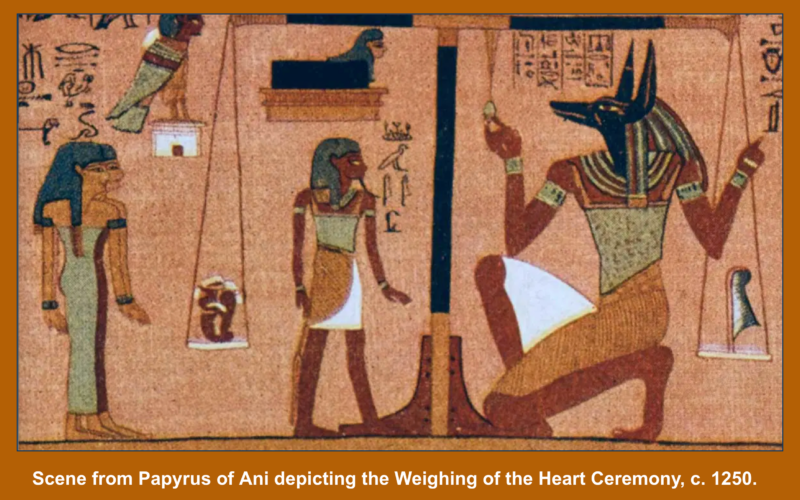
When I think of a soul hanging in the balance, I have a mental image from the ancient Egyptian Book of the Dead: each person’s heart weighed on a scale opposite a feather that represented truth and justice. A heart unburdened by sin would be as light as the feather… which is how we hope to feel tomorrow night when we emerge from this day of teshuvah and prayer.
In antiquity, the heart was understood to be the seat of the self. Today we might locate selfhood in the balance between head and heart. The botanist and writer Robin Wall Kimmerer is one of my role models in this.
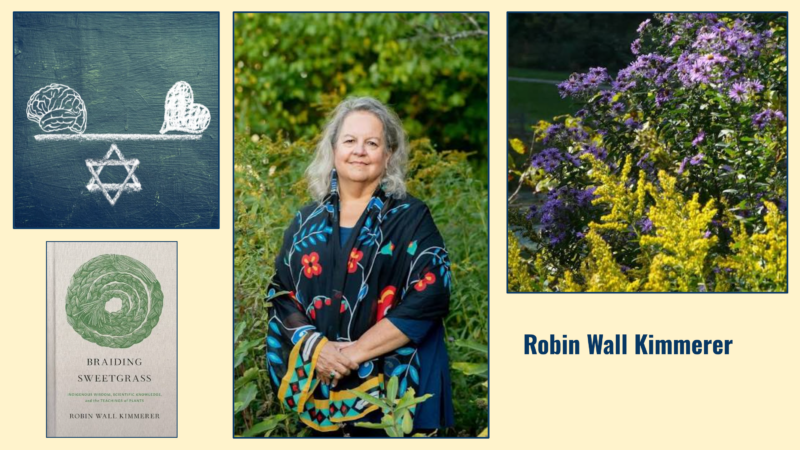
She is a member of the Citizen Potawatomi Nation, maybe best known for her book Braiding Sweetgrass. Early in the book Kimmerer writes that in college she became fascinated by the visual beauty of asters and goldenrod blooming together. “Why is the world so beautiful? It could so easily be otherwise: flowers could be ugly to us and still fulfill their own purpose. But they’re not.”
So she went to a professor and asked if there were an explanation for why these two plants are so beautiful together. He dismissed her question, saying, “that’s not science.” If you want to think about beauty, he chided, go to art school or become a poet. And for a time she thought that in order to learn science she needed to try to forget the life of the spirit. To be all brain, no heart.
Kimmerer didn’t grow up speaking Anishinaabe. This is part of the ugly legacy of white colonialism: so-called “Indian boarding schools” that beat their pupils if they tried to speak their native tongue. She began learning her ancestral language as an adult, and she describes her frustration at wildly unfamiliar syntax.
There is a verb that means, “to be a Saturday.” Another that means, “to be a bay.” She admits that reading about this, she wanted to throw her textbook across the room: this doesn’t make any sense! A bay is a noun, it can’t be a verb! And then she realized:
A bay is a noun only if water is dead… “To be a bay” holds the wonder that, for this moment, the living water has decided to shelter itself between these shores… To be a hill, to be a sandy beach, to be a Saturday, all are possible verbs in a world where everything is alive. Water, land, and even a day, the language a mirror for seeing the animacy of the world, the life that pulses through all things.
In Anishinaabe plants and rocks and trees and lakes and even days are understood to be animate – alive, containing spirit.
Of course as a Jew I love the fact that Saturday is considered to be animate, even though the Potowatomi didn’t inherit our sacred story of Shabbat. But more than that, I love the idea that there is (or can be) sacred spirit in everything, if we have eyes to see. What Kimmerer calls “The life that pulses through all things” – what we call shefa, divine abundance, or Shekhinah, Divine Presence – can be found anywhere. Our 24-hour news cycle can feel deadening. Can we balance that by looking for the life in everything?
Western science told Kimmerer there was no reason for asters and goldenrod to grow together, and that their beauty in our eyes is incidental. But when she dug into the question she realized that because purple and yellow are reciprocal colors, both for humans and for pollinators, they attract more pollinators together than they would alone. As she says, “It’s a testable hypothesis, it’s a question of science, a question of art, and a question of beauty.”
And just as purple and yellow are complementary colors, Native wisdom and “western / scientific” wisdom can be – should be – complementary. Kimmerer doesn’t need to set aside her Native eyes in order to see and value science or vice versa. She doesn’t need to choose head over heart.
On the contrary: she sees more deeply – and so do we – when holding these two wisdoms and ways of being in balance. In her words, “We see the world more fully when we use both.”
Kimmerer is talking about the kind of balance where we want to hold two things in dynamic tension. Jewish tradition also speaks of another kind of balance between order and chaos, or between good and bad. In that case, we want to be out of balance. We want to push the scale toward good.
R. Shneur Zalman of Liadi, known as the Alter Rebbe, lived in the late 1700s in Belarus. He was a scholar and a mystic whose most famous work is known as the Tanya, and in that book, he writes:
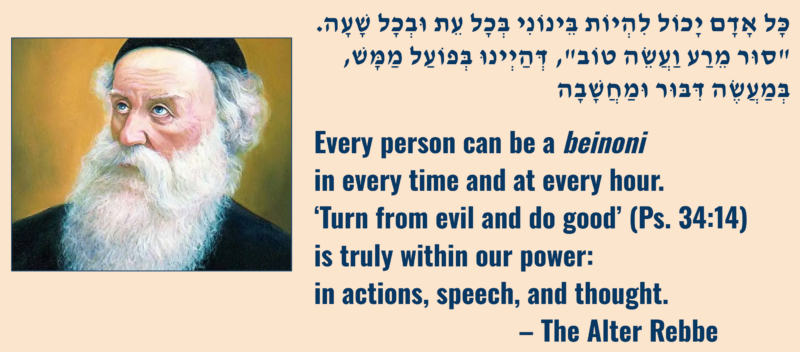
בֵּינוֹנִי Beinoni literally means in-betweener: someone who is neither a רָשָׁע rasha, wicked, nor a צַדִיק tzaddik, wholly righteous. For the Alter Rebbe, this is a spiritual state to which we can all aspire. “Let’s all be in-between!” To the modern ear, that doesn’t sound so great. Who aspires to be “mid?”
Here’s another way to say it: being a beinoni is our natural spiritual state. No one is naturally completely wicked – though making harmful choices can desensitize us to causing harm, and someone who does that is likely to become less and less good on any meaningful ethical scale. And no one is naturally completely righteous. Even Moshe, the conduit through whom tradition says we received Torah, wasn’t completely righteous all the time.
We all have a יצר הטוב yetzer ha-tov, a good inclination, and a יצר הרע yetzer ha-ra, an “evil” inclination. And our tradition says we need both. There’s a story in Talmud that the rabbis managed to trap an aspect of “the evil inclination” for three days. Imagine if we could capture the essence of ego and selfishness and chaos and mess and unkindness and wickedness, the whole range of things we might consider to not be “good.”
And in that story, it says: for the three days that the yetzer ha-ra was trapped, no eggs were laid in all the land. There was no desire, no creativity, no generativity. The world just stopped still. It turns out we need both of our impulses, the “good” one and the “bad “one – toward order and toward chaos – or our emotional and spiritual world stops turning. It’s in the tension between them that life happens. We live – we must live – in the balance.
Here’s the great thing about being in-between: it means our choices matter. Here’s Rambam, aka Maimonides, one of Judaism’s greatest systematic thinkers. He lived in Spain around the year 1200, and he writes:
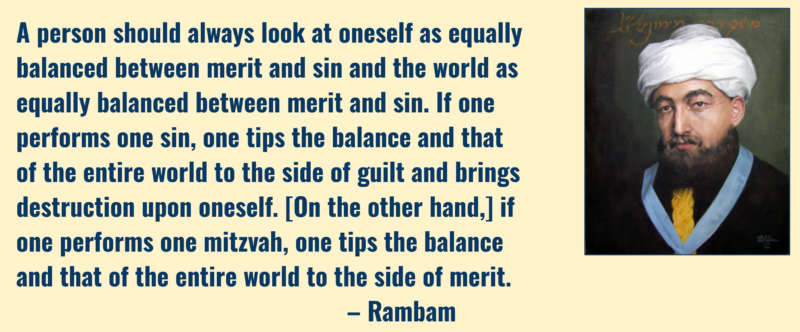
Each choice we make has the potential to shift the balance of our lives, even the balance of the world.
We also need to balance humility with healthy self-esteem. This comes from R. Yissachar Dov Baer, who lived like the Alter Rebbe in the late 1700s. He teaches: before we begin to pray, we should understand ourselves to be אַיִן ayin: no-thing, nothingness. Who are we to stand before the greatness our ancestors named as God?
I know that for some of us, the notion of a relational God – a presence or force in the universe with which we seek to be in relationship – is deeply meaningful. And I know that for some of us the concept feels alienating at best. But I think this teaching can “work” no matter what our theology might be. Try this on: faced with the almost unimaginable vastness of space and time, who am I? I’m a speck. All of human history is an eyeblink in geological time.
(Here’s a 5-minute video about that and a one-hour video about that. I especially like the long one, which I listen to sometimes while writing.)
And in the same teaching he also says we need to remember that לית אתר פנוי מניה leit atar panui mineih, “there is no place devoid of God” – including within us, in our imperfections. Again, I know that for some of us the God-language rings like a bell and for others it’s just static. Try this on: we are part of the vast Mystery of creation and consciousness, and therefore we must celebrate our value and potential and connection to the whole.
This is the balancing act of being human: remembering that we are nothing, and we are also a spiritual fractal or a fragment of the Infinite.
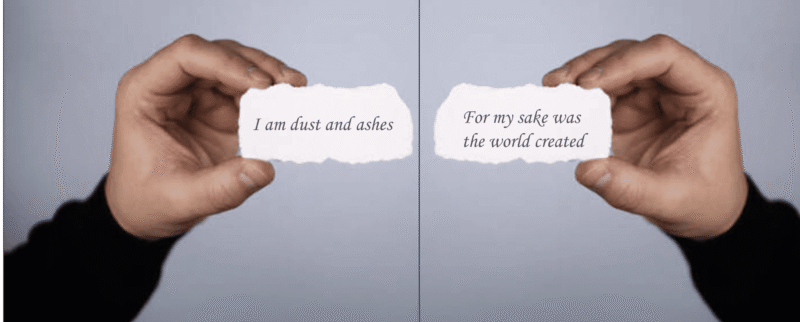
It’s like R. Simha Bunim’s two slips of paper, one that reads “for my sake was the world created,” and the other, “I am dust and ashes.” Some of us find it easier to hold on to one, some of us lean toward the other. Balance asks us to notice which one we most need in every moment.
Balance is not a static state. We might more accurately aim for the act of balancing. It’s like harmony: each note needs to be in balance with the other. Balance challenges us to hold disparate truths simultaneously.
I’m not talking about a moral relativism where there’s no right and wrong. Rather, the kind of situation in which Tevye the Dairyman could famously say, “You’re right… and you’re right!” Like: I could say that Judaism values particularism. And someone else could argue, no, Judaism values universalism. And we would both be correct, even though universalism and particularism can feel opposed to one another. Balance means holding the whole in which both can exist.
Balance means holding the whole in which, as I said on Rosh Hashanah morning, the world feels like a trash fire and also we live with profound beauty and reason for hope. Balance means leaning into both/and.
Kimmerer recognizes this, writing, “Balance is not a passive resting place—it takes work, balancing the giving and the taking, the raking out and the putting in.” This is true of stewarding a piece of land, and it’s also true of stewarding our souls and hearts. We are called to balance between despair and hope, between workday and Shabbat, between raking out and putting in. Between “I am dust and ashes” and “the world was made for me.”
And today we balance between everything that came before, and everything that will be. Between last year’s choices and this year’s new beginnings. Between knowing where we’ve screwed up, and also knowing we can do the work to make amends.
I invite us to move through this Yom Kippur seeking to be conscious of the life in everything around us: the great willow in our back yard, the paving stones of the meditation labyrinth, the goldenrod and the asters. I invite us to spend this day practicing our balance of head and heart, and our balance of temporariness and eternity: the knowledge that someday we will be gone, and gratitude that right now we are here, we are living, we can choose to change.
A few weeks ago, in an article about the environmental potential inherent in wooden skyscrapers, I read these lines from Norwegian poet Alf Prøysen:
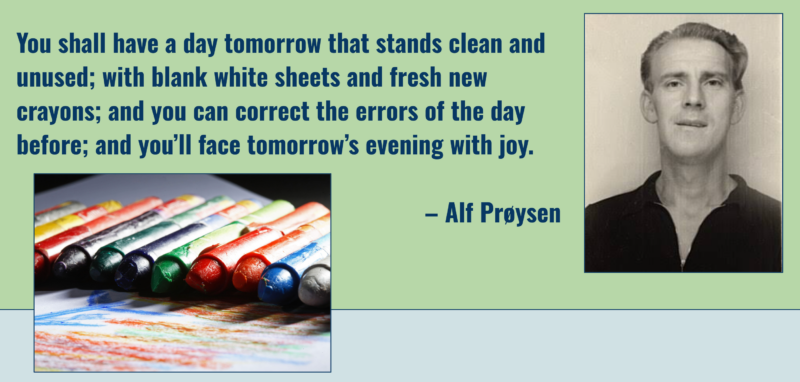
It’s a beautiful benediction for any day… maybe especially for this one.
Here in this doorway between summer and fall, between the old year and the new, everything hangs in the balance around us and within us. Rambam would say, one act of teshuvah could tip the scales on the future of the world. This is the work of these 25 hours. Are we ready to begin?
This is the sermon that Rabbi Rachel Barenblat offered during Kol Nidre 5787 evening service on Sunday, September 20, 2026.