Guest Post: “The Practice of Finding Balance”
By Ziva Larson
This guest sermon was offered by cantorial soloist Ziva Larson during Erev Rosh Hashanah 5787 evening service on Friday, September 11, 2026.
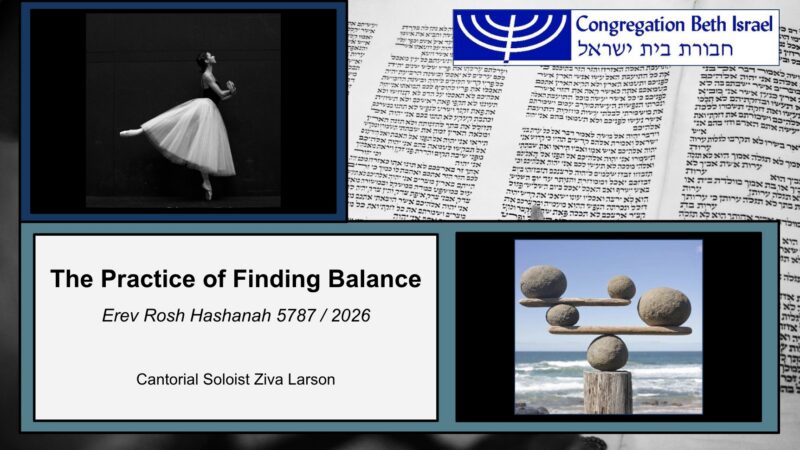
B’ruchim haba’im – welcome to all of you, both here at CBI and on Zoom. I am so grateful to be able to be in community with you during the High Holy Days this year.
Our theme for the High Holy Days at CBI this year is balance. When we think of balance, we often think of stillness, completion, a fixed state, or perfection. But, perhaps surprisingly, balance is none of these things. So what exactly is balance?
I’d like to invite you to try an exercise with me. You are welcome to participate or observe as feels right for you. If your body permits, I invite you to stand up. Let’s take a moment to notice our breathing. You don’t need to change anything. Just notice your breath. Now, find a fixed point on which to focus your gaze. Carefully, try to balance on one or two feet. You can rest the toes of your lifted foot on the ground or hold onto a chair or wall near you for support if needed. You can also try this from your chair, lifting one foot partially or completely off the ground and balancing in your seat. While balancing, notice what is happening in your body. Is there any movement or tension? Where do you notice it? For example, I notice the muscles in my foot and ankle are contracting and relaxing as they work to stabilize me.
Thank you for doing this exercise with me. You may be seated.
In the balance exercise we just did, our bodies were continuously working to balance and stabilize through many small muscle movements and adjustments. In finding balance, our bodies were not still, but in constant motion.
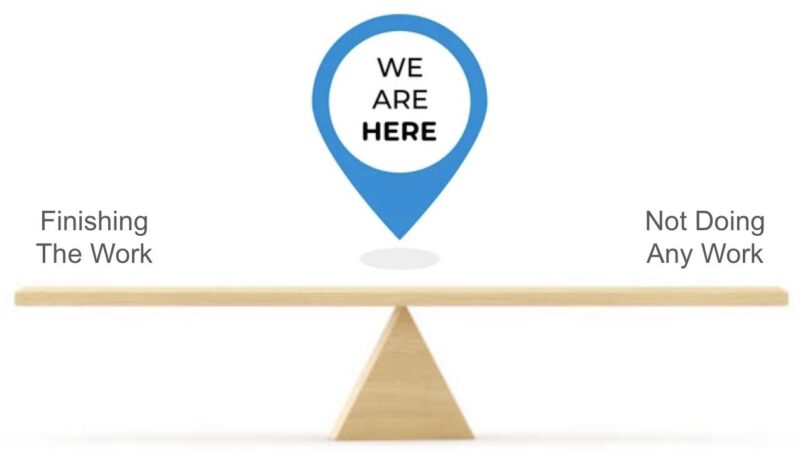
So what does this have to do with Judaism or the High Holy Days? For me, it brings to mind words from Mishnah. In tractate Pirkei Avot (2:16), Rabbi Tarfon, one of our sages, says, “It is not your duty to finish the work, but neither are you at liberty to neglect it.” Here, we see another example of balance. According to Rabbi Tarfon, in between “finishing the work” and “not doing any work” is where it is our moral duty to be. This state of balance is not static. It involves work and continuous adjustments.
If we define “work” as doing the right thing, then we can think about this more concretely. No one is able to operate at 100% all the time. If we don’t take time to rest and take care of ourselves, we will be unable to do the work required to do the right thing, help and support others, and work to repair the world. As the saying goes, “you can’t pour from an empty cup.” We must find a balance between working and taking care of ourselves. Since we are human beings and not machines, finding this balance requires continuous adjustments in how we are navigating our lives.

It also requires effort and courage. Many times, doing the right thing is not easy. Often, it might be easier and safer to mind our own business, do what we are told, follow the rules, not rock the boat, and not risk conflict or consequences. It can be incredibly challenging to disrupt the status quo or go against loved ones or authority figures in favor of doing what is right. We see two examples of this in the Torah portions we read for Rosh Hashanah.

In Genesis 21 (Gen. 21:9-14), which we will read tomorrow, Sarah demands that Abraham evict the enslaved woman Hagar and Ishmael, the son of Hagar and Abraham, and abandon them in the desert because Sarah does not want her son, Isaac, to have to share his inheritance with Ishmael. Abraham is distressed by Sarah’s demand and consults God, but God only reinforces Sarah’s demand. Even though it is clearly unjust and wrong, Abraham quietly accedes to Sarah’s and God’s demands and fails to protect Hagar and Ishmael, abandoning them in the desert.
Similarly, in Genesis 22 (Gen. 22: 1-13), which we will read on the second day of Rosh Hashanah, God instructs Abraham to kill his son Isaac and offer him as a burnt offering to God. Again, even though this is clearly wrong, Abraham remains silent and fails to protect Isaac. The only reason Isaac survives is because of the timely appearance of a ram in the thicket and a sudden change in God’s instructions to Abraham, who is now commanded to sacrifice the ram instead of Isaac. Again, Abraham remains silent and simply does what he is told.
Abraham’s silence and compliance in the face of injustice and harm is a stark example of how our failure to speak up and do what is right perpetuates injustice and harm. When we have a choice between doing what is right and what is easy, it is vital to do what is right. Of course, we are all only human. We may not always achieve this goal. However, recall our balance exercise and remember that balance entails constant motion, not completion or perfection. Even though we are not perfect, it is essential that we still consistently work to do what is right.
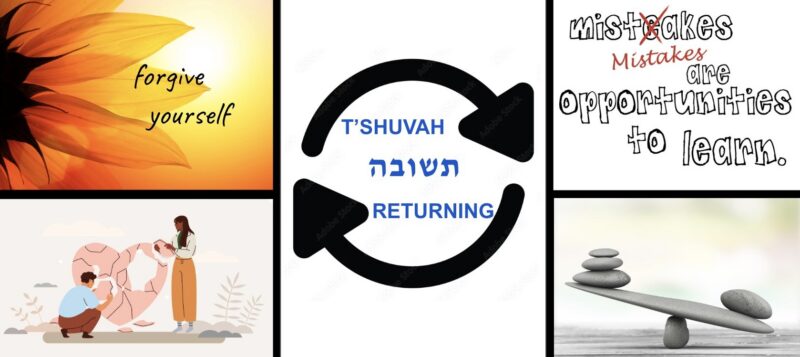
This brings to mind the idea of t’shuvah (returning to our best self) and chesbon hanefesh (the accounting of our soul), two of the themes of these Yamim Nora’im, these Days of Awe. During this time, we are invited to honestly reflect on our past year and notice where we lived in alignment with our values and where we may have misstepped. Then, through the process of t’shuvah, we can learn from those missteps, make repairs when possible, and gently release our missteps and forgive ourselves. In this way, we can mitigate any buildup of tension and imbalance both in ourselves and between ourselves and others that might result from ignoring or dismissing our missteps and restore balance to our lives.
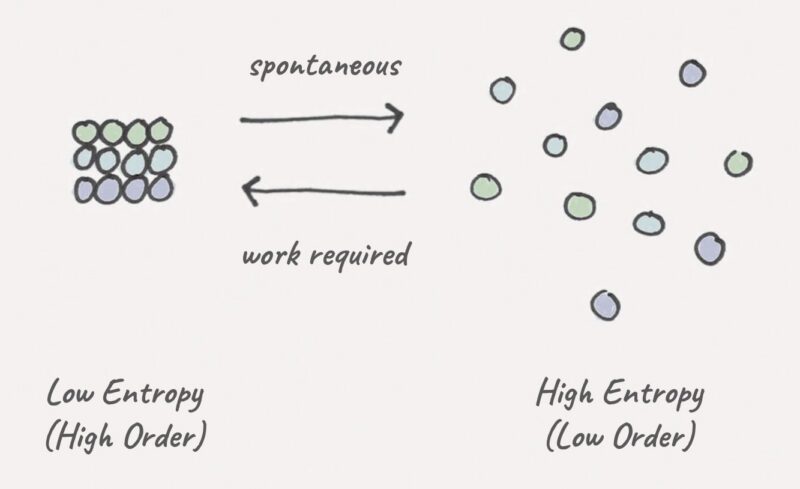
Acts of healing – for ourselves and others, such as through tikkun olam (working to repair the world) and through t’shuvah (returning to our best self) – are part of the process of maintaining balance. According to a scientific concept known as the Second Law of Thermodynamics, entropy, or the overall disorder in a closed system (such as the universe), always increases over time. In other words, nature, of which we are a part, spontaneously moves from order to disorder, and balance is lost. Every year, therefore, the Yamim Nora’im, the Days of Awe, are an opportunity to work to address this imbalance and to find balance again.
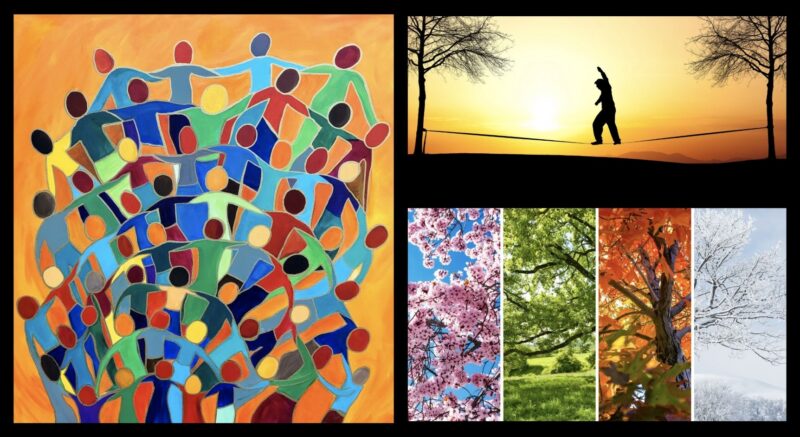
Of course, it is important to engage in the practice of finding and maintaining balance throughout the year. However, the High Holy Days give us a structured and supportive opportunity for finding balance in community with others. This process becomes not just an individual reflection and rebalancing, but also a communal one. We are all in this together, and together, just like the many muscles in our bodies constantly readjusting to help keep us upright, we help to maintain the balance in this world.
In these times of great injustice, harm, and pain, it may be easy to feel like nothing we do matters, like the problems in our world are too great to overcome. Furthermore, especially when there is a personal risk of conflict or consequences, it can feel much easier and safer to be like Abraham and remain silent and compliant in the face of injustice and harm. However, to paraphrase what we learned earlier from Mishnah (Pirkei Avot 2:16), it is not our duty to individually do all of the work to fight injustice and evil, but neither can we neglect doing what is right.

A line spoken by the character Gandalf in The Hobbit: An Unexpected Journey, one of Peter Jackson’s film adaptations of author J.R.R. Tolkien’s works, highlights the importance of each one of us making the choice to do what is right, even when it is not easy. Gandalf says, “[Some believe] that it is only great power that can hold evil in check, but that is not what I have found. I’ve found it is the small things, everyday deeds of ordinary folk, that keeps the darkness at bay. Simple acts of kindness and love.”
In other words, everyday choices by ordinary people to do the right thing matter and are essential in keeping the balance from tipping all the way into great evil and darkness.
But how do we consistently make the choice to do what is right when things feel overwhelming and hopeless and when we are afraid? Again, a dialogue from The Lord of the Rings: The Two Towers, another of Peter Jackson’s film adaptations of author J.R.R. Tolkien’s works, seems particularly pertinent and offers both a reason to keep doing the hard work of doing what is right, even when all seems lost, and a sense of hope.
This exchange between two of the main characters, hobbits named Frodo and Sam, occurs near the climax of their perilous journey, when Frodo is exhausted and losing all hope.
Frodo says, “I can’t do this, Sam.”
Sam replies, “I know. It’s all wrong. By rights we shouldn’t even be here. But we are. It’s like in the great stories, Mr. Frodo. The ones that really mattered. Full of darkness and danger they were. And sometimes you didn’t want to know the end. Because how could the end be happy? How could the world go back to the way it was when so much bad had happened? But in the end, it’s only a passing thing, this shadow. Even darkness must pass. A new day will come. And when the sun shines it’ll shine out the clearer. Those were the stories that stayed with you. That meant something. Even if you were too small to understand why. But I think, Mr. Frodo, I do understand. I know now. Folk in those stories had lots of chances of turning back, only they didn’t. They kept going. Because they were holding on to something.”
Frodo asks, “What are we holding on to, Sam?”
And Sam replies, “That there’s some good in this world, Mr. Frodo. And it’s worth fighting for.”
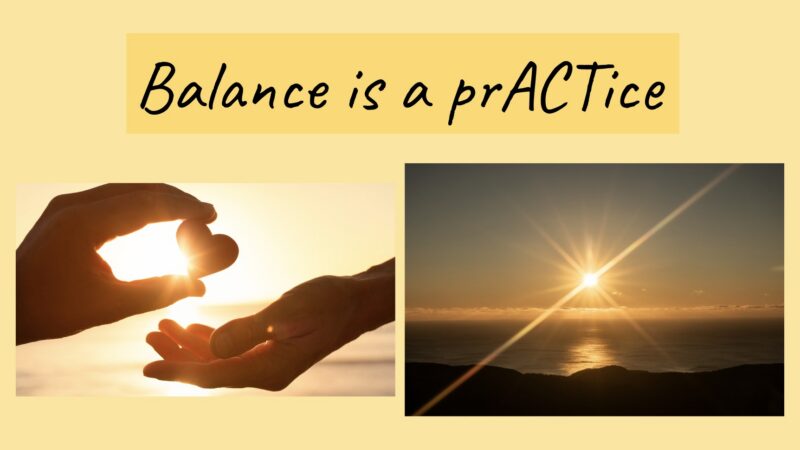
Like Sam, and, I imagine, like many of you, I believe that there is some good in this world and that it is worth fighting for. I also believe that times of darkness will pass and new, brighter days will come if we all consistently engage in acts of kindness and love and consistently make the choice to do the right thing.
Therefore, my hope and my challenge for us all in the coming year is that we strive to return to balance in our lives and in our world, remembering that balance does not mean completion or perfection. Rather, it is a constant process and a practice. It is my hope and my challenge for us all that we use the practice of finding balance to make space in our lives and capacity in ourselves to be able to consistently engage in acts of kindness and love and to consistently make the choice to do the right thing so that we can help repair the world and open the door to brighter days ahead.
Kein y’hi ratzon. May it be so. Shanah Tovah.
References
- Jackson, P. (Director). (2002). The lord of the rings: The two towers [Film]. New Line Cinema.
- Jackson, P. (Director). (2012). The hobbit: An unexpected journey [Film]. Metro-Goldwyn-Mayer; New Line Cinema; Wingnut Films.
- Jewish Publication Society (2023). The JPS Tanakh: Gender-sensitive edition.
- Genesis 21:9-14: https://www.sefaria.org/Genesis.21.9?lang=bi&aliyot=0
- Genesis 22:1-13: https://www.sefaria.org/Genesis.22.1?lang=bi&aliyot=0
- Mishnah. (n.d.). Pirkei avot (Dr. Joshua Kulp, Trans.). https://www.sefaria.org/Pirkei_Avot.2.16?lang=bi