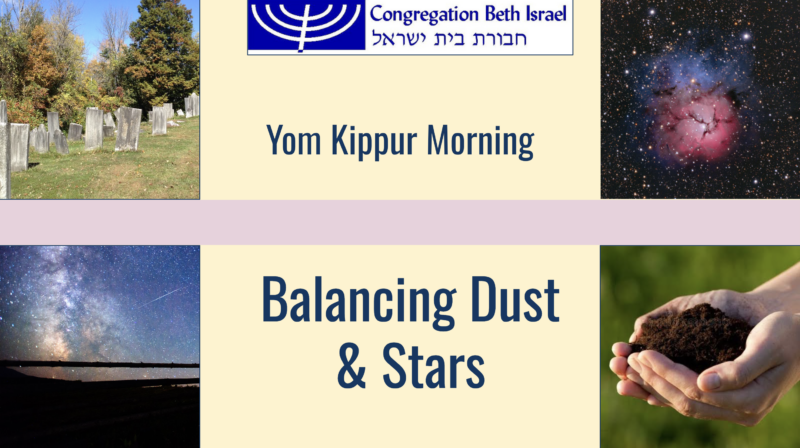
One of the things I do with my son, in our spare time, is watch television shows and talk about what they teach us about being a good human being.
First was The Good Place with its lessons about morality and second chances. Since then we’ve watched Ted Lasso, ostensibly about an American football coach who becomes a soccer coach in Britain but fundamentally about ethics. And Bojack Horseman, an absurdist and dark cartoon about modern life and addiction that turns out, in the end, also to be about ethics – and about what it might look like to not be capable of making teshuvah as one lives with the consequences of what one’s done.

Several months ago he introduced me to another grown-up cartoon based on a comic book called Invincible. And given this preface, you will not be surprised to hear what we’ve found in it. I don’t want to spoil you, so I’m going to be vague: there’s a character who comes from an alien race of powerful and long-lived beings. And at first, this character doesn’t much see the point of life on earth. Our lifespans are so short, and so caught-up with creating things that don’t last: childhoods that are gone in an eyeblink, relationships that don’t endure…
And then this character encounters another planet where the people live for a span of weeks, maybe a couple of months. Their whole lifecycle passes within a single Earth season. And despite himself he falls in love with one of them, whose life is of course short. And then he mourns, and he rages at himself: why am I so invested in the life of something so brief and meaningless? But of course, that life isn’t meaningless.
What gives a life meaning is not its duration, and it’s not the accomplishments of the person living it. It’s something far less measurable.
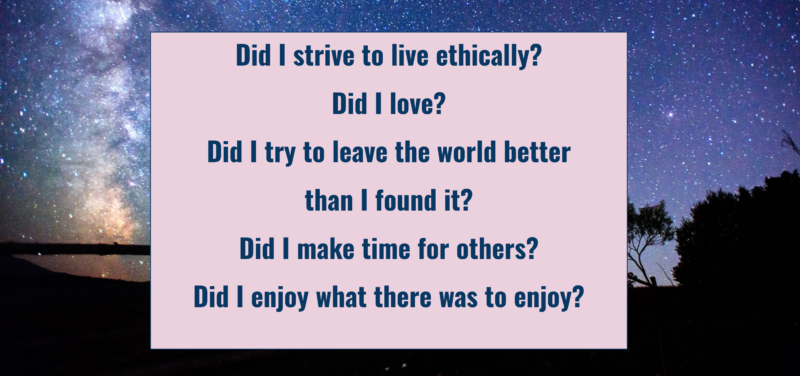
The sages of the Talmud posited a different set of five questions that they imagined we would be asked when we die (Shabbat 31a).
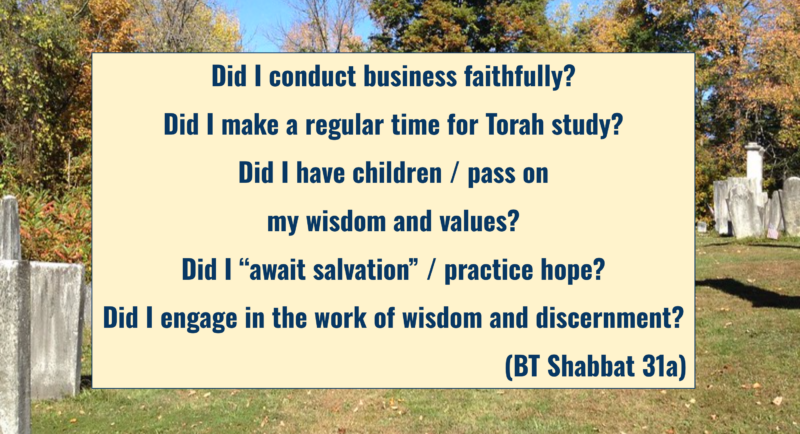
Did we conduct our business faithfully – in other words, were we ethical? Did we make a regular time for Torah study, e.g. for learning? Did we have children – or, understood more broadly, did we pass on our wisdom and our values to others? Did we “await salvation” – today we might say: did we cultivate hope? Did we engage in the work of wisdom, sifting among competing values to discern what we understand to be true?
These are questions for adults. When a child’s life is cut short, something with which our community continues to grapple, maybe the only question that matters is: in their short life, was there love?
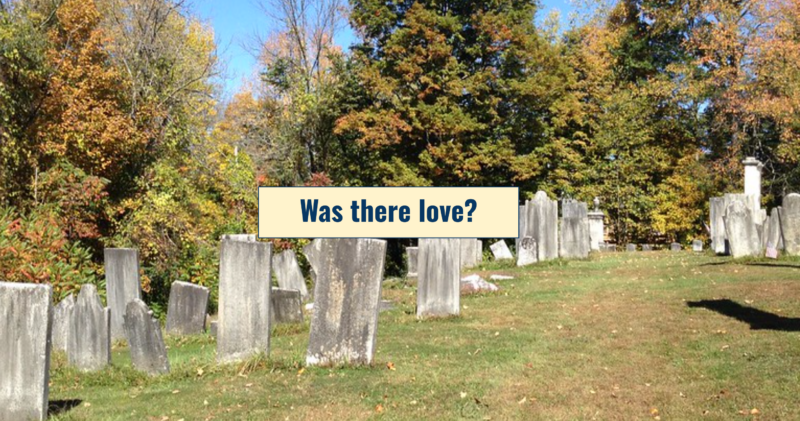
We don’t have to accept any of these questions as the fundamental measure of a life well-lived. But today is a day for sitting with whatever questions we think are core. “Make teshuvah the day before your death” (Avot 2:10) means make teshuvah now, because we never know if we’re going to get a tomorrow. That came home to me last Yom Kippur when I experienced several mini-strokes on the bimah. As Torah teaches, we come from dust and to dust we return. (Gen. 3:19)
And oh, something in me resists that! I think it’s my ego – not in the sense of “the part of me that self-aggrandizes,” but the part of me that just can’t imagine not existing. Tonight during Ne’ilah, our closing service, we’ll read words from the poet Marge Piercy:

The ego cries out, “I! I! I!” I exist, I’m here, I matter, I can touch things, I can change things! Yes. And our lives aren’t forever. Someday this “I” will cease to be, and the world will keep on turning. Today is a day of rehearsal for our death, a day of remembering that we are dust. And in balance with that feeling, I also believe there is something in us that is eternal. Our tradition calls it the soul, and we imagine it as a “chip off the God block,” a spark of the Eternity we name as God.
I know that not everyone here shares that theology. And that’s okay! I’ve told you this before: I have a book called Jewish Views of the Afterlife and it’s several inches thick. As a people we have held so many different views and beliefs about God and about death I can’t begin to name them all. So if the notion of an eternal soul feels like a fairy tale to you, that’s ok. Seeing it the way I do is not a requirement for being Jewish.
One of the things I love about Judaism is that our beliefs about God and about the afterlife don’t need to have much impact on our choices in this life. There’s a God? Ok! We should behave ethically! There’s no God after all? Ok! We should still behave ethically! Our ethical imperatives are real no matter what.

Maybe you’d prefer to think of us as stardust. We are literally made from elements that were formed billions of years ago in deep space. In these words adapted from Carl Sagan:
Our little planet floats like a mote of dust in the morning sky. All that you see, all that we can see, exploded out of a star billions of years ago, and the particles slowly arranged themselves into living things, including all of us. We are made of star stuff. We are the mechanism by which the universe can comprehend itself.
I hold the fairly standard Jewish belief that when my body is done, my soul will return to its Source. And because I’m one of those Jews who believes in reincarnation, I can comfort myself with the thought that when it comes to the souls I love the most, maybe I’ll get to play in this sandbox with them again in another life.
But even if that isn’t so, I know that when my body is done with this life my physical being will return to this beautiful earth, and the elements that made up my body will return to the soil. What a deep form of teshuvah – usually rendered as “repentance,” though it literally means “return.”
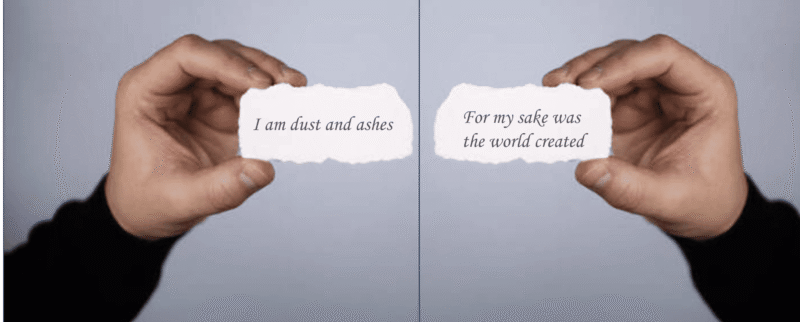
Here come R. Simcha Bunim’s two slips of paper again: “The world was made for me,” “and I am dust and ashes.” We are temporary, and we are forever. We are dust, and we are stars.
I see this balance in the work of the hevra kadisha, the volunteer burial society. It was over 20 years ago that Darlene Radin first called me to say that someone in our community had died and there was a need for the hevra kadisha to gather after work. She knew that R. Jeff Goldwasser, who was the rabbi here in those years, had encouraged me to join.
That day when Darlene called, I said yes. And I have never stopped being glad that I did.
Hevre means friends, and kadisha means holy. This group of “holy friends” is the volunteer society that does taharah – washing, blessing, and dressing the body of someone who has died – and shmira, “guarding” or keeping watch, e.g. keeping company with someone’s body so their soul doesn’t feel abandoned between taharah and burial. These mitzvot of hesed shel emet, caring for the dead, are a core part of Jewish practice at least since Talmudic times and probably far longer.
Our practices are simple and profound. When there is a death, the hevra kadisha gathers. It’s a bit like a volunteer fire department; not always the same people every time, though there are folks who always participate and others who come when they can. We shake off the day and center ourselves. We read an opening prayer.
We go into the taharah room and speak to the person who has died, explaining what we’re there to do and asking them to forgive us if we make mistakes. And then, maintaining sacred silence, and doing everything we can to protect the dignity of the person on the table, we gently wash them. We simulate a mikvah, a pool of living waters, with a stream of water and a prayer. We gently dry them and dress them in linen shrouds – the same simple white garments for everyone, regardless of station. We tuck them into a plain pine casket, and wrap them in a white sheet.
The first time I did this was 2005. I was in rabbinical school. I wrote at the time that the whole process felt tender and caring. It made me think of what I imagined it might be like to bathe and swaddle a baby in clean white cloths: caring for someone who can’t care for themselves.
Doing taharah feels even more poignant to me now that I have reared a child. In some ways it is very like tending to a baby. It’s hard to believe that my six-foot-two double bass player was ever tiny and helpless, but he was. We all were, once. And if we live long enough, we will be again. And when our lives have ended, someone will tenderly wash and dress us one last time.
I take a deep comfort in knowing that someone did these things for my parents when they died. Someone did this for my grandparents, and their grandparents, and their grandparents. Someday someone will do it for me.
That’s another way of connecting beyond life and death. Hesed shel emet, the truest kind of lovingkindness: a favor that can’t be repaid, only paid forward. The sacred work of the hevra kadisha reminds me that we are dust: we come from earth, and to earth we return. And it also reminds me that life is sacred, and that we are a reflection of God. Of course, you don’t have to believe that in order to participate in the work of the hevra kadisha, any more than you have to believe it in order to be here today. You just have to believe that taking care of one another matters.
![[L] R. Arthur Waskow z"l. [R] A galaxy.](https://cbiberkshires.com/wp-content/uploads/2026/09/YK-2026-RB-09.png)
This morning we used an interpretive second paragraph of the Sh’ma from R. Arthur Waskow, zichrono livrakha. Reb Arthur was one of my teachers who died in December at the age of 92. I have a memory of him from the first week we met, back in 2002, when he ended a week-long class with a unique kaddish d’rabanan (“scholars’ kaddish”) – the special form of the kaddish that’s traditionally recited to “seal” a session of learning together.
We stood in a circle holding hands as Reb Arthur spoke about the “Great Name.” All forms of the kaddish, including the one we say after learning and the one we say in mourning, begin the same way: Yitgadal v’yitkadash shmeih rabbah, magnified and sanctified be the Great Name. But what is the “Great Name,” exactly?
In one understanding it’s the four-letter name יהו׳׳ה, the one many of us grew up hearing that we aren’t “supposed” to speak, or maybe we’ve forgotten how to speak. Reb Arthur is the one who taught me to see that Name in our breath: if the vav is sounded as a w, those four letters together sound like breathing. We pray that holy Name with every breath we take.
But at the end of our learning he gave us a different way to see it. He invited us to think about those who’d taught us. And those who had taught them. And those who had taught them. Generations of names of teachers going back. And he invited us to think about those whom we teach. And those whom they teach, and generations of students rippling forward. Each of our names in this chain of learning is like a star in the vastness of the sky. All of our names together make up the Great Name of the One.
The endless chain of learning and teaching is holy, and each person who learns or teaches adds some brightness to that infinite constellation. The things we teach can outlast us. The impacts we make on each other can outlast us. Just as the actions of the hevra kadisha outlast any given member of that group, because we pass the kindness forward to people who will pass it forward. Like the elements in our bodies that were here long before we were, and will be here long after we are gone.
And that brings me to Emily Levine, zichrona livracha, with whose words I want to close this morning. I find her wisdom perfectly consonant with my Jewish beliefs about the soul, though I think this one may speak also to the rationalists in the room. I love how matter-of-fact she is. I love her gratitude. And I love her sense – which to me is very Martin Buber, very “I-and-Thou” – that when we bear witness to one another, we make each others’ lives real. (I think it’s worth hearing her speak! But if you prefer, there’s a transcript below.)
I’m going to first tell you something that in my grandmother would’ve elicited a five-oy alarm: oy-oy-oy-oy-oy. And here is it. Are you ready? Ok. I have stage IV lung cancer. Oh, I know, “poor me.” I don’t feel that way. I’m so ok with it. I simply don’t understand the mindset of people who are out to “defeat death” or “overcome death.” How do you do that? How do you defeat death without killing off life?
It doesn’t make sense to me. I also have to say, I find it incredibly ungrateful. It’s disrespectful to nature. The idea that we’re going to dominate nature, we’re going to master nature, nature is to0 weak to withstand our intellect? No, I don’t think so. I am incredibly grateful for life, but I don’t want to be immortal. I have no interest in having my name live on after me. In fact, I don’t want it to. I love being in sync with the cyclical rhythms of the universe. That’s what’s so extraordinary about life: it’s a cycle of generation, degeneration, regeneration.
“I” am just a collection of particles that is arranged into this pattern, and then will decompose and be rearranged and be available, all of its constituent parts, to nature, to reorganize into another pattern! To me that is so exciting, and it makes me even more grateful to be part of that process. I look at death now from the point of view of a German biologist, Andreas Weber, who looks at it as part of the gift economy. You’re given this enormous gift: life. You enrich it as best you can, and then you give it back.
And you know, Auntie Mame said “life is a banquet.” Well, I’ve eaten my fill. I have had an enormous appetite for life. I’ve consumed life, but in death I’m going to be consumed. I am going into the ground just the way I am! And there, I invite every microbe and detritus-er and decomposer to have their fill – I think they’ll find me delicious.
So the best thing about my attitude, I think, is that it’s real. You can see it, you can observe it, it actually happens. Well, maybe not my enriching the gift, I don’t know about that – but my life has certainly been enriched by other people. And I am so grateful to you. I don’t want to say “the audience,” because I don’t really see it as we’re two separate things. I think of it in terms of quantum physics again. And as you know, quantum physicists are not exactly sure what happens when the wave becomes a particle. There are different theories – the collapse of the wave function, decoherence – but they’re all agreed on one thing: that reality comes into being through an interaction.
So do you. And every audience I’ve had, past and present. Thank you so much for making my life real.
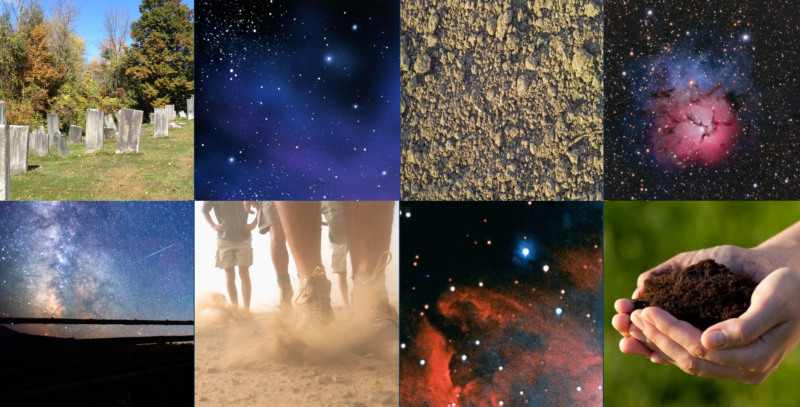
May our remembrance of those whom we’ve lost make their lives real for us again as we begin Yizkor in a few moments – no matter what we believe about our origins and our endpoint: in the dust, or in God, or in the stars.
This is the sermon that Rabbi Rachel Barenblat offered during Yom Kippur 5787 morning service on Monday, September 21, 2026.