Earlier this week I sang El Maleh at the countywide memorial for the victims of the Oct. 7 attacks. I remembered what it felt like to wake up on October 7th three years ago, at the tail end of the long season of Jewish holidays, to the news that kibbutzim were under attack, that a music festival was under attack. The terrible images. The feeling like we couldn’t catch our breath. Sometimes I still feel like I can’t breathe with it.
As I remember the horrors of that day I also remember that the people of Gaza have experienced unthinkable destruction. More than 75,000 people killed, alongside more than 2,000 Israelis. Whole cities leveled. The devastation is more than I can imagine. And each death, in either of these two peoples, reverberating outward across networks of grief and loss. Sometimes I still feel like I can’t breathe with that, either.
If Facebook is any indication, some would argue that because I just mentioned both of these I am minimizing one or the other of them. That’s another thing that leaves me spiritually short of breath: the sense that we’re expected to “take sides” even in feeling grief. “One who destroys a life, it is as though they destroyed an entire world.” (BT Sanhedrin 37a) Empathy and grief are like love: they’re not zero-sum.
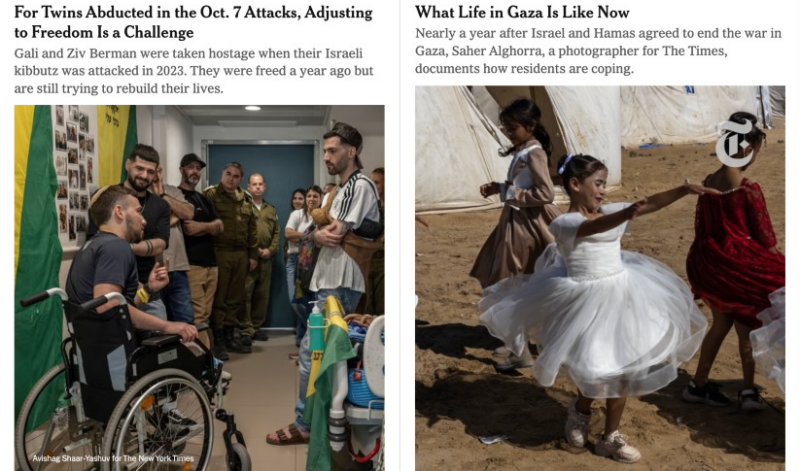
I opened the New York Times on Wednesday morning (Oct. 7) to this juxtaposition. Right there, side-by-side: one story about Oct. 7 hostages trying to figure out how to find wholeness after an ordeal I can’t begin to imagine. And another about Gazans trying to find wholeness after an ordeal I can’t begin to imagine. I saw those, and I thought: how does anyone begin again, carrying this kind of loss and grief?
In Jewish Journeys, our Hebrew school, I’m teaching a class this semester called Big Moments and Hard Questions in Torah. And in our first class last week we looked at an excerpt from this week’s Torah portion, the story of creation, culminating in the creation of human beings. And then I divided my students into two teams, and invited them to debate whether or not it was a good idea for God to create humanity.
The kids taking the “no” side had an easy time coming up with reasons why humanity was a bad idea. War, violence, corruption, environmental destruction, the climate crisis – many reasons why humanity is a net negative. The kids taking the “yes” side had a harder time, which made my heart ache. I had to help them a little: have human beings created anything worthwhile? How about music, art, philosophy? How about love?
Maybe some of this is a function of growing up in a time of climate crisis. Or a time when rights are being taken away, when democracy feels vulnerable. Maybe it’s because on some level our kids soak up our mood, and a lot of us are struggling. And of course we are. It’s not easy to begin again when we’re carrying so much loss and grief: for Israel, for Gaza and the West Bank, for the United States, for our fragile planet.
So I taught them a midrash (Bereshit Rabbah 8:5). God says, “let Us make humanity in Our image.” Our sages ask: to whom is God speaking? To the angels who were created before humanity, of course! The midrash says:
When God began to create the first human, the angels banded into groups, some saying “Let them be created,” and others saying, “Let them not be created.”
Lovingkindness said, “Create! Because humanity will perform acts of lovingkindness.”
Truth said, “Don’t create! Because humanity will be full of falsehood.”
Justice said, “Create! Because humanity will do justice!”
Peace said, “Don’t create! Because humanity will be full of strife.”
What did God do? God took truth and threw it to the ground.
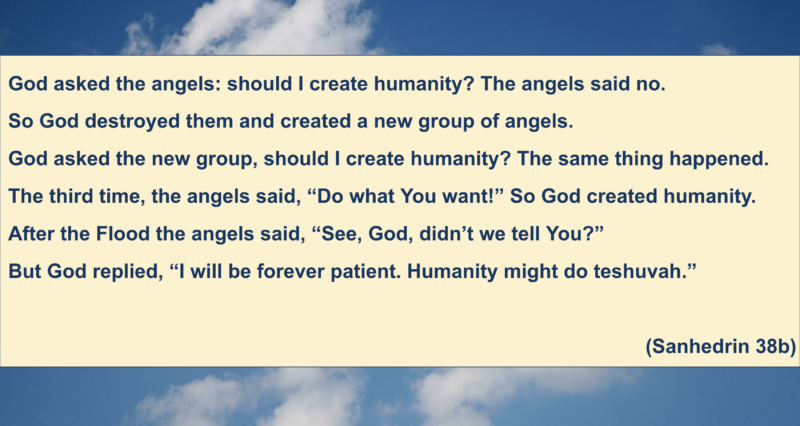
Sit with that for a second, because it’s kind of wild. The angels seem evenly divided, and they have legitimate reasons on both sides. But God seems to want us to exist. God wants to be in relationship with human beings who have free will. It’s true that we will tell lies and create war. But we will also love and create justice. So God shoves truth and creates us anyway. Here’s another version (in Sanhedrin 38b):
As the Hasidic master Reb Nachman teaches, if we believe we can break, we must also believe we can repair. Instead of destroying, we can build. Instead of harming, we can heal. Instead of making war, we can make peace. I know this sounds pollyanna and arguably implausible. But fundamentally, Judaism teaches that repair is always possible. That’s the original meaning of tikkun olam: repairing the broken world.
I find strength in the words of Yonatan Zeigen, the son of murdered peace activist Vivian Silver, in a recent email from Standing Together: “I don’t believe peace is naïve, and I don’t believe it is less plausible than war…Peace and partnership are not questions of plausibility. They are questions of will – of our determination, our imagination and our political courage.” I find strength in knowing people are working toward that future.
How do we begin again when we’re carrying grief? In my friend R. Mike Moskowitz’s words, “We partner with G-d to make the world better.” God brought us into being knowing we would be imperfect, and still calls our existence tov, good. When we do what’s right, we live up to that. It’s the best antidote I know to grief and overwhelm. It’s our calling as human beings and as Jews. One heartbeat, one step, one choice at a time.
This is the d’varling that Rabbi Rachel offered at Kabbalat Shabbat services.