The first known Black mutual aid society was the African Union Society, formed in Newport, Rhode Island in 1780.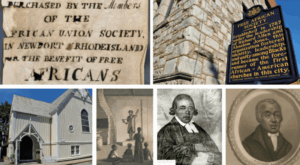
Seven years later, African Americans in Philadelphia formed the Free African Society to provide benefits to the needy, aid for the ill and unemployed, and burial assistance. By 1838 there were a hundred of these societies in Philadelphia alone. After the civil war, free Black Americans started credit unions when White-owned banks wouldn’t serve them. They pooled resources to buy farms and land, to care for widows and children, and to bury their dead.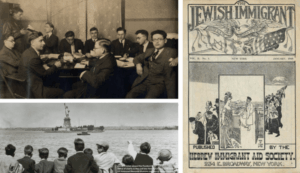
I’m not sure if my ancestors knew they were following in those footsteps when, in the late 19th and early 20th centuries, Eastern European Jewish immigrants formed landsmenschaftn, mutual aid societies rooted in shared geographic origins. These organizations provided everything from English lessons and social support, to basic instruction in democracy, to loans when someone was sick or out of a job, to burial plots. In 1938, the WPA counted nearly 2500 landsmanshaftn in the New York area alone.
The experience of these two communities is not the same. One community was brought to these shores in chains and enslaved. The other community endured pogroms and then concentration camps before fleeing here for refuge. Those differences are important, and today they aren’t my focus. What grips me, especially this year, is how both communities responded: by stepping up to take care of each other.
In both of these stories, there is need, and there are members of a community rising to meet that need. For an increasing number of us – for many Jews, for people of color, for queer and trans folks, for immigrants and refugees – these are times of crisis. How will we take care of each other now? Do we even feel like an “us” now?

In the second century of the Common Era, the sage Hillel taught אַל תִּפְרֹשׁ מִן הַצִּבּוּר, “Do not separate yourself from community.” (Pirkei Avot 2:4) Commenting on this teaching a thousand years later Rambam taught that separating ourselves from community is itself a sin, even if we don’t transgress in any other way. If we don’t do mitzvot together, or share in each others’ times of hardship and joy, then he said we will have no portion in the World to Come. Whoa, that is some strong language.
“The World to Come” sometimes means the afterlife, and it sometimes means the dream of a messianic future where there is no suffering or enmity or sorrow, and it sometimes means a future of hope that we can’t quite yet see. But one way or another Rambam says if we withdraw from community, we lose our stake in that.
Contemporary philosopher R. Yakir Englander makes a more mundane but no less critical observation: if we separate from community, we lose our capacity to effect change. “Effective critique must come from within a society,” he writes (in Al Tifrosh Min Ha-Tzibbur). “ Social reformers, to have any influence on the hearts of their people, must be one of them in their pain and struggles.”
But most Americans do separate from community. Social and civic engagement have dropped “by every conceivable measure” over the last 75 years. Most Americans have leaned into heightened individualism rather than community.
Just look at how many Jews choose not to join shuls… and it turns out most people are even less likely to join other civic organizations like neighborhood associations, hobby or sports groups, even labor unions.
Echo chambers on the internet made it easier to seek people with whom we already agree, and to knock those with whom we disagree. (And, of course, in this particular moment it seems that across our nation we disagree on matters as fundamental as vaccine science.) The early years of the Covid-19 pandemic were isolating in a variety of ways – necessary in order to save life, and, they still had an impact on community connection or disconnection. And especially in the last few years, many of us have felt isolated by the experience of moral injury – watching unethical things unfold in our world, and feeling implicated in them but also unable to address them in any meaningful way.
Sadness, depression, and grief can also cause one to withdraw from community. And with everything that’s broken in our world, the number of us who are grappling with depression and grief has skyrocketed. The Hasidic master known as R. Nahman of Breslov (d. 1810) wrote (in Likkutei Moharan), “When someone is depressed, the solution to their depression is to take the depressed person and to draw them into the circle of community.” He counsels us to “make the depression dance” – to draw the depressed person into community, even if they say they just want to be alone.
This wisdom reminds me of the teaching that we should do mitzvot even if we’re not “feeling it,” and in time, maybe feeling will come. I light Shabbat candles every week. Sometimes I feel a spiritual uplift. If I waited for the uplift before I could feel ready to kindle the candles, I might never get there.
Mark Williams and Danny Penman, authors of Mindfulness, emphasize the need for this approach – doing the thing so that the feeling will come, rather than the other way around. But how many of us approach community in this way, reaching in and connecting with each other even when we don’t feel like it?
Rabbi Alan Lew z”l, author of This Is Real And You Are Completely Unprepared: the Days of Awe as a Journey of Transformation, teaches that when we look deep inside we discover that we all share one heart. In truth, we can’t fully separate from each other. We are part of something together, whether we want to admit it or not. We are interconnected.
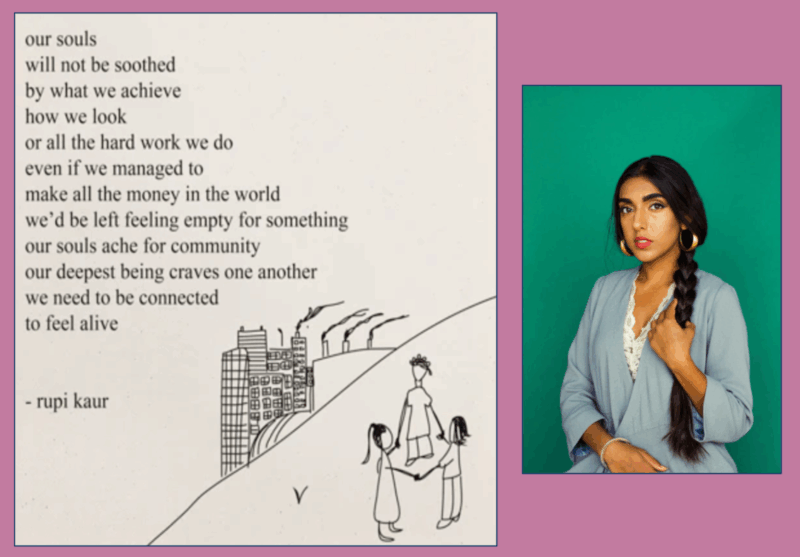
In the words of poet Rupi Kaur:
How can we strengthen the habit of being part of community, instead of feeling apart-from?
Many of us are familiar with the idea that in stressful situations we have the choice to push back or to run away – “fight or flight.” But in 2000, psychology professor Shelley Taylor gave name to a different phenomenon. “When threatened or stressed, humans typically affiliate with one another instead of attacking each other.” She called this the drive to “tend and befriend.”
Notably, this is most common among women, who are usually more socialized to be caregivers and community-builders. I’m fascinated that this set of behaviors is talked-about so much less than is “fight or flight.” I’d never heard of “tend and befriend” until this year! But I love it as a paradigm for how we can respond to difficult times.
What would community life rooted in “tend and befriend” look like?
I think we’d check in on each other. I think we’d reach out to people who are struggling. I think we’d show up with positive words and kindness. I think we’d try to ensure that no one feels abandoned, and that systemic injustices are redressed.
I think we’d stand up for our immigrant neighbors, and stand against the call for mass deportation. I think we’d stand up for the right of parents and their pediatricians to determine the best medical care for their kids. We’d stand up for free speech, even when we disagree with it – because we know that historically we all flourish where there is due process and free speech, and we know that when people are imprisoned for unpopular speech, everyone is less safe.
Here’s a piece of wisdom from Rebecca Solnit that I am holding close to my heart this year. She writes:
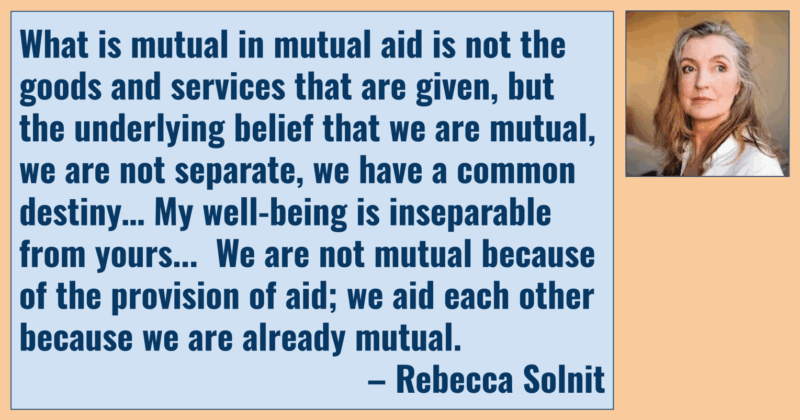
We are not separate: this is a fundamental spiritual truth, a piece of deep wisdom that’s found in many different religious traditions including our own. This is true of every “we” – we, the Jewish people; we, the synagogue; we, the community of northern Berkshire; we, all of us, bound in a shared destiny and a covenant of mutual care.
And we can support each other even when we don’t wholly agree. I invite us this year to let go of purity politics, by which I mean, only standing with those with whom we have complete alignment on every issue. I think that kind of rigidity is a danger to both democracy and Jewish community. Purity politics is binary, “with us or against us.” Real community and coalition are complex.
Robert Reich teaches that, “Living a moral life in an age of bullies requires collective action; it cannot be done alone.” And collective action – coalition – community – invites us to value what connects us even as we differ. When I stand out on the town green, I know I don’t agree with everyone on everything. But I find strength and comfort in the places where we agree, and I’m grateful that we can let our differences coexist.
The more I study and wrestle with these issues, the more committed I am to the proposition that especially as Jews we don’t need to see everything the same way in order to stand together. Civil rights attorney Alejandra Caraballo describes these times as “a sustained state of emergency.” Every day, a new outrage. The best response to times like these is to lean into building coalition and connectedness and community. We can do that – we must do that – even when our views aren’t identical.
Building coalition requires willingness to step outside our comfort zone. And I think that’s good for us! We can strengthen our capacity to tolerate emotional discomfort, even to grow from it. Building coalition asks us to be in relationship, and to not walk away when we disagree. This takes work. I’m not always good at it. But I’m trying.
Disconnection and alienation can feed despair. Connection, on the other hand, nourishes hope.
And some of Jewish life’s deepest opportunities for connection don’t ask us to agree. When someone needs a minyan for kaddish, or needs pallbearers to help them carry their loved one to the grave, what matters is that we show up.
It’s easy to fall into the habit of seeing community – especially Jewish community – as a fee-for-service affair, something transactional. You pay your dues and in return you get customer service, and if you don’t like the customer service you can go somewhere else. But especially in these times of climate crisis and constant global and political emergency, we need our communities to be more than that.
Community is not something a rabbi, or even a rabbi-and-a-board, can provide: it’s something we all co-create. It’s corny to say that it needs all of us, but it really does. It’s mutual: community needs all of us – and we need community.
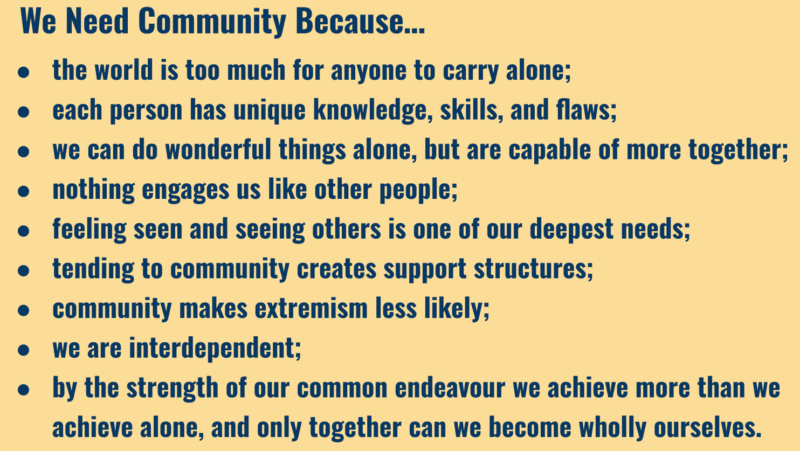
A week or two ago, I asked online why we need community. Here are some of the answers I received:
“Fight” and “flight” have a strong pull on American culture. It’s easier to butt heads, or to run away, than to negotiate our differences. But imagine with me a year of “tend and befriend” – a year of showing up for each other and for our community. Imagine what a difference we could make for each other. That’s what I want us to carry away from tonight. What a difference we can make for each other when we remember we’re not alone.
This is the d’varling that Rabbi Rachel offered at Kol Nidre services on Wednesday, October 1, 2025.