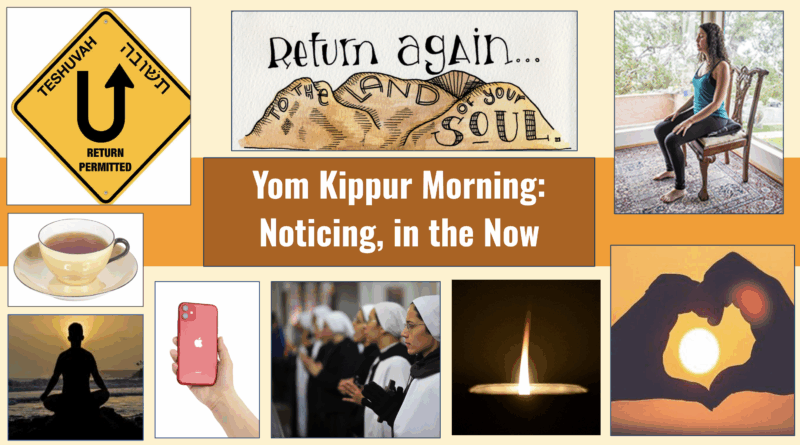
This summer I went on my first clergy retreat with the Institute for Jewish Spirituality. As instructed, I detached from my technology. I wrote in a paper notebook instead of on a laptop. I didn’t read emails or texts. I didn’t look at the news. I focused instead on being present in meditation, in prayer and song, and in sacred community.
It had been about twenty years since the last time I took a retreat without any contact. Even on most rabbinic retreats (and certainly at rabbinic conferences), I’ve had my phone with me.
To be clear, this is not an anti-technology sermon. Technology is how I talk to my best friend who doesn’t live in town. Technology is how I see pictures of my new great-nieces and nephews. Technology is how I do most of my Torah study! But technology also often draws me, and us, away from here and now. And for those of us susceptible to the pull of the news and social media, sometimes our tech doesn’t help us be healthy or whole.
It is the nature of the mind-heart to take on the flavor of whatever we marinate in. And our brains didn’t evolve to constantly hold this much stress and grief. An adrenaline-fueled fight-or-flight response served our ancient savannah ancestors well when they were literally being chased by wild animals… but our systems are flooded with that same rush of cortisol when we read the news headlines every morning.
Several of you asked me:
My days on retreat helped me notice that my relationship with the news is not great for me. Perennially refreshing the news keeps me feeling anxious and often griefstricken, literally unable to take a deep breath. And once I’m in that place, my habits keep me there unless I make a conscious effort to choose otherwise.
Instead of constantly refreshing the news, I’m trying to fill my cup with stories that remind me we can take care of each other and we can build a better future. Lately that means watching Parks & Rec with my kid, and admiring how Leslie Knope really cares about public service. And rereading Naomi Kritzer’s story The Year Without Sunshine, in which people take care of each other in a time of crisis that looks very like our own. And mining the texts of our tradition for reminders of how our forebears found hope and holiness during tough times. The stories that nourish you might be different ones. But find them, and immerse in them. Stories help us make meaning. We need stories that uplift the best of who we can be.
At IJS, they reframe the common meditative practice of “following the breath” as a practice of teshuvah. In every moment we can return to the breath and return to awareness. Every inhale is a chance to return again.
I went to this rabbinic retreat thinking that I was lousy at meditation, mostly because my mind never shuts up. Also because if I allow myself to sit still, my body seizes the opportunity to fall asleep. Those things are still true, but I’m learning to see them differently. The point of meditation isn’t perfect serenity: it’s noticing what is, right here, right now. And practice doesn’t end when I get up from my chair. Standing in line at the drugstore: an opportunity for noticing. Sitting in traffic because the road’s under construction: an opportunity for noticing. Every breath: an opportunity for noticing.
And every breath is an opportunity to unclench and to practice holding my assumptions and expectations lightly. I know how it went when I sat in meditation last time, or how I felt when I prayed last night, but I don’t know what today’s going to be. Change is always possible. Something new is always possible. Or at least – I can always strive for curiosity, without judgment. “Let’s see what happens now!” It’s an internal embrace of not-knowing.
Alongside these practices of noticing and curiosity, I also try to practice hakarat ha-tov, literally “recognizing the good.” This Jewish practice comes to us from the world of mussar, spiritual and ethical self-improvement work.
I realize this may sound like fiddling while Rome burns. The world is literally on fire and I’m prescribing gratitude practice?! Yeah, actually, I am. I think noticing what’s good, and remembering to cultivate gratitude, is essential in difficult times.
Alan Morinis, the founder and director of the Mussar Institute, writes:
“When you open yourself to experience the trait of gratitude, you discover with clarity and accuracy how much good there is in your life. Whatever you are lacking will still be missing, of course, and in reaching for gratitude no one is saying you ought to put on rose-colored glasses to obscure those shortcomings. The obstacles to appreciating the good can also be very real, especially when life is riven by suffering. But it is worth the effort to practice gratitude, especially since the one who benefits most is the one who is suffering. Recognizing the good affirms life.”
Hakarat hatov doesn’t mean that all of our needs will immediately be met, or that we will be free from suffering. I don’t think either one of those is actually possible. But gratitude practice can change how we experience what is.
The risk is that gratitude practice can lead us into spiritual bypassing: the habit of using spiritual language to paper-over what’s broken in our lives. It isn’t good for us to insist that everything’s great when it’s not. But it also isn’t good for us to overfocus on what’s terrible without also paying attention to what’s sweet. Sometimes noticing what’s sweet amidst the bitter takes some work. Enter gratitude practice.
Anybody here think I’m just saying that because I’m a rabbi and I’m trying to talk you into a spiritual practice? Maybe this will sway you. I learned recently about a continuing longitudinal study to examine the onset of Alzheimer’s disease. The study began in 1986, and it’s colloquially known as “the Nun Study.” In this case I don’t mean n-o-n-e as in “none of the above,” I mean Catholic religious women.
Seven hundred American nuns, all members of the same order, agreed to work with a research team investigating the process of aging and Alzheimer’s disease. At the start of the study, participants ranged in age from 75 to 102. Here’s where this gets interesting to me: in 1930, their mother superior had asked each of them to write a spiritual autobiography exploring their reasons for entering the convent. The researchers analyzed those documents and then interviewed the nuns, with hopes of discerning whether there was anything to be learned from comparing their emotional state in 1930 and their emotional state 60 years later.
And here, in the words R. Jonathan Sacks, is what they found:
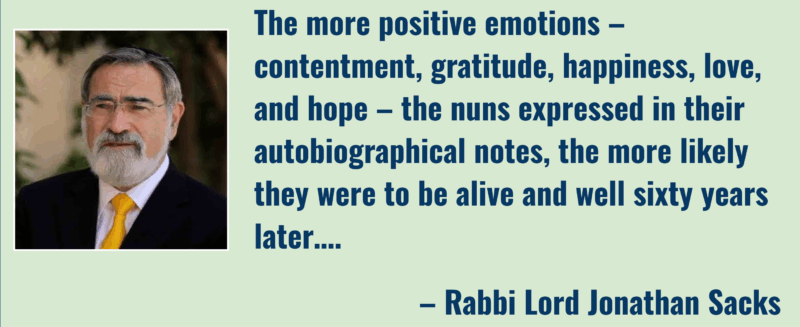
We’ve all had the experience of negative thoughts stealing our joy, whether those thoughts come from within us or from outside of us. But gratitude practice can mitigate that. And noticing what’s good – remembering to say “thank You” for what’s good in our lives, whether or not we “believe in” God – seems to be correlated with living not only more happily but also longer.
This is my recipe for wholeness in these times. First, as I spoke about last night, leaning in to community. “Tend and befriend.” No one is in this alone. Then:
- filling our cup with stories that remind us who we can be;
- returning to our aspirations – both returning to the breath, and returning to who we aspire to be;
- maintaining gentle curiosity;
- cultivating awareness of what’s good;
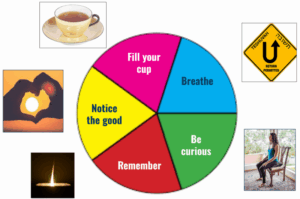
And – this is important – we don’t need to be having a good day in order to do any of these. We don’t need to wait until the world is no longer on fire. These are practices for now, whatever now is. The final component is:
5. remembering.
Remember that we are part of a chain of generations. Remember our spiritual ancestors, and learn from how they flourished even in difficult times. Remember that we are not alone. Remember that others will carry our traditions forward when we are gone.
On the day after the United States bombed Iran this summer, I encountered these words from writer and theologian Anne Lamott, the author of Bird by Bird and Help, Thanks, Wow. She began her column by describing the feelings of overwhelm I suspect many of us recognize from reading the news most days. She acknowledged that the drumbeat of constant crisis can wear us down, and that we might have all kinds of feelings about our nation attacking Iran. (Or about any of the horrors that have happened in our world since then.) And then she wrote:
“We will have hope again… because we always do again, eventually. We have to remember that today. Susan B Anthony’s great niece said in times of horror and hopelessness, “We remember to remember.” We remember having come through the apparent end of the world other times, and of having resurrected.”
The resurrection language is very Christian, of course. Which makes sense; Anne Lamott is clear and upfront about what Jesus means in her life! But the idea of remembering to remember – that is about as Jewish as it gets. In our prayers we constantly remember the Exodus from Egypt. We remember our people’s history and our collective memory. We remember how, exiled by the waters of Babylon, we wept when we remembered Zion. (A mere 2600 years ago.) We remember our ancient dreams of a messianic future in which the work of healing creation will be complete.
During these Days of Awe, we ask God to remember us for life. And: all the practices I’ve been talking about this morning are ways of remembering ourselves for life. They help us do what we can to really be here and now while we’re here. Because Yom Kippur also comes each year to remind us that someday we’ll be gone. All of these are practices for helping us be present in what Mary Oliver calls —
— actually, I’ll let her say it, at the very end of this poem.
This is the d’varling that Rabbi Rachel offered at Yom Kippur morning services (as a lead-in to Yizkor / Memorial services) on Thursday, October 2, 2025.