Dear Congregation Beth Israel members and friends,
One of the things we do on Yom Kippur is pray the prayers of Yizkor, the memorial service that takes place four times a year: at Passover (spring), at Shavuot (summer), at Yom Kippur (fall), and at Shemini Atzeret (also fall – a mere 11 days after Yom Kippur).
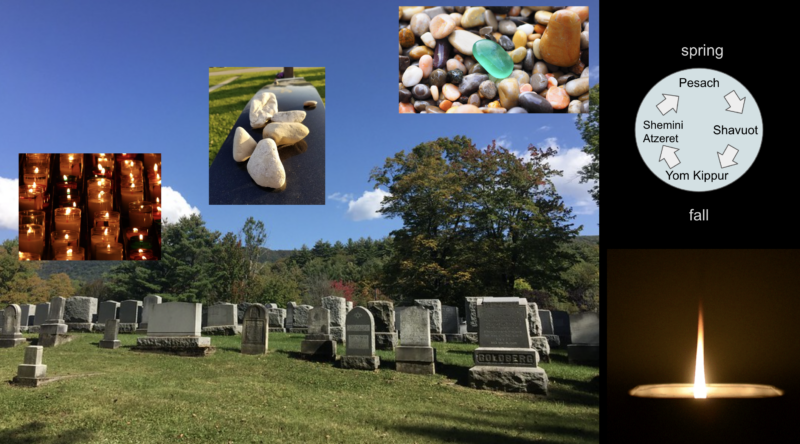
R. Arthur Waskow of blessed memory taught that the fourth of these memorial services might once have been in winter, to balance out the year with remembrance once during each season. But because travel was difficult in wintertime (and in those days the big festivals asked of us a pilgrimage to Jerusalem) the fourth one got moved to the end of Sukkot when people were already at the Temple. One way or another, this is the rhythm we’ve inherited… and, that said, I know that for most of us the only Yizkor / Remembrance service that really registers is the one on Yom Kippur.
Some synagogues hold Yizkor late in the day, to entice folks back for the afternoon and evening services that culminate Yom Kippur. At CBI we hold our Yizkor late in the morning, at the end of morning services, when most of us are already at shul.
We’ll be teaching about the Yizkor service – its origins, its meaning, its imagery, and how to “feel into” those images in advance so we already have connections with them when the holiday comes around – at our next Worth A Thousand Words class at 7pm on Tuesday, September 1. (You are welcome to join us for that class even if you haven’t attended previous ones – just let me know so I can send you the login info and, if you want it, the link to previous class recordings.)
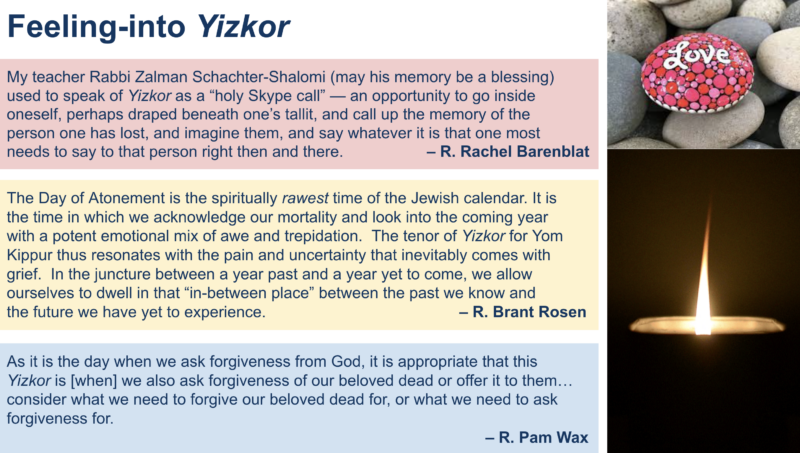
This is an advance glimpse at one of our slides for that class, containing small teachings about Yizkor – one from R. Brant Rosen, whose rendering of Psalm 23 is among my favorites, and the other two from R. Pam Wax and from me. I hope these quotes offer food for thought and contemplation as the Yom Kippur Yizkor approaches.
Some of us grew up with the Ashkenazi custom of seeing Yikzor as only suitable for those who were mourning parents or other immediate-family losses – even going so far as to get up and leave the sanctuary when Yizkor began, lest we be seen as courting the evil eye and “asking” the universe for our loved ones to die. (Oy!) I think the time for that superstition is long behind us, and I invite all of us to stick around for Yizkor on Yom Kippur morning (Monday, September 21).
For anyone who has experienced a loss, Yizkor is an opportunity to remember those who have died and to recommit ourselves to living lives of meaning in their honor and memory. And for those of us who are fortunate enough to not have anyone to mourn, it’s an opportunity to accompany others in our community so that no one is mourning alone.
I hope you’ll join us Tuesday evening for a deep dive into the images and meaning of the Yizkor memorial prayers, and I look forward to remembering our loved ones with you on Yom Kippur morning.
Blessings to all,
— Rabbi Rachel Barenblat
For more on what to expect from this year’s Days of Awe, see my From the Rabbi column for August on why Rosh Hashanah changes when it falls on Shabbat and why that matters.