My son is working on a musical composition that draws on one of the major and most familiar high holiday melodies. The other night he said something like, “it feels like the whole year leads up to the high holidays – it’s new beginnings, and it’s also the time when we look back on our mistakes and try to make teshuvah.” My first reaction was: I love the fact that we have conversations like this. I feel so lucky.
My second reaction was: yes – the Days of Awe are an annual chance for introspection. In order to really start anew, we have to look back on who we’ve been and do our best to make amends for where we’ve fallen short. Though Jewishly, it doesn’t have to be just a once-a-year thing. There’s the ritual of Yom Kippur Katan, a monthly pause for teshuvah before new moon, for instance. But most of us don’t learn about / experience that.
And then along comes this week’s Torah portion, Nasso, with an instruction about what to do when we sin against a fellow human being, “thereby breaking faith with God.”
דַּבֵּר אֶל־בְּנֵי יִשְׂרָאֵל אִישׁ אוֹ־אִשָּׁה כִּי יַעֲשׂוּ מִכּל־חַטֹּאת הָאָדָם לִמְעֹל מַעַל בַּיהֹוָ”ה וְאָשְׁמָה הַנֶּפֶשׁ הַהִוא׃ וְהִתְוַדּוּ אֶת־חַטָּאתָם אֲשֶׁר עָשׂוּ וְהֵשִׁיב אֶת־אֲשָׁמוֹ בְּרֹאשׁוֹ וַחֲמִישִׁתוֹ יֹסֵף עָלָיו וְנָתַן לַאֲשֶׁר אָשַׁם לוֹ׃
Speak to the Israelites: When a man or woman has committed any wrong toward a fellow human being, thus breaking faith with YHVH, and they have realized their guilt, they shall confess the wrong that they have done. They shall make restitution in the principal amount and add one-fifth to it, giving it to the one who was wronged. (Num. 5:6-7)
When we miss the mark in our relationships with each other (a misstep bein adam l’havero, “between a person and their fellow”) we thereby miss the mark in our relationship with God (a misstep bein adam l’Makom, “between a person and their Source”). It’s such a simple teaching, and so profound. When we cause harm, we break faith with God. (And then there’s the second part: what we owe. I’ll come back to that.)
R. Adin Steinsaltz (d. 2020) unpacks this to mean that that someone who sins against a fellow person, “betraying the trust of another through theft, stealing, or cheating,” sins against God. It’s easy to say: oh, but we don’t do any of those things. We don’t steal or cheat; this isn’t speaking to us. But Jewish tradition understands mis-steps in broad and nuanced ways, including this one, and it turns out we might do this one after all.
Our tradition understands that it’s possible to steal someone’s joy by giving them bad news, or just by being negative. It’s possible to steal someone’s Shabbat by complaining and thereby ruining a sense of peace, or to steal someone’s good name / reputation by repeating gossip or more broadly speaking about someone behind their back. Some of us studied this together last summer in last year’s pre-high-holiday prep class:
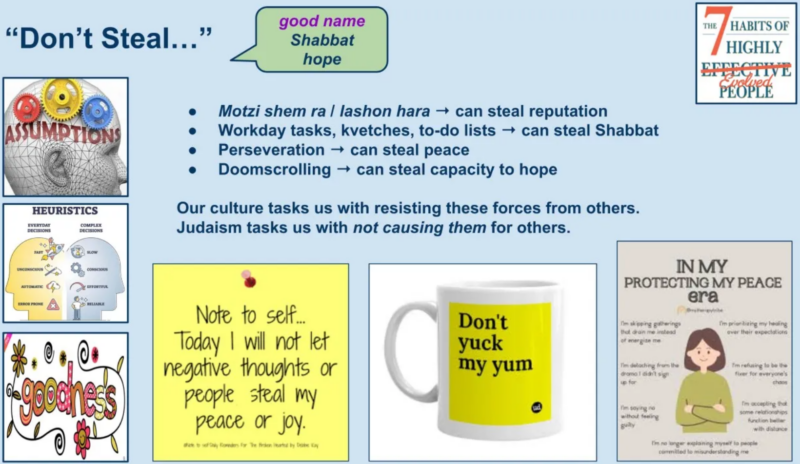
When we think of places where we miss the mark, missteps like these might not occur to us — but the tradition has a lot to say about them. The tradition also has a lot to say about our obligations to the community at large. For instance, we’re supposed to ensure that every community has a doctor, a school, a court of justice, a tzedakah fund. I also think we have secular obligations, like vaccination to protect the immunocompromised.
Alongside this week’s parsha and commentaries, I read Tuesday’s May 26 Letter from an American. Heather Cox Richardson wrote that day about the second Letter from Delaney Hall, written by people detained by ICE. The authors of that letter apologize for entering the country illegally, explain that they were fleeing persecution and violence, and note that upon arrival they turned themselves in to border authorities.
They followed legal processes, got court dates, paid taxes, and worked legally while their immigration cases were in process. They were detained at scheduled immigration check-ins. They are now enduring inhumane conditions, including lack of medical care, rotten food, and threats of deportation to third countries (e.g. not their place of origin; and to places including Congo where there is an active Ebola outbreak).
This week’s parsha teaches us that when we sin against one another, when we miss the mark in a relationship, we need to make the other person “whole” – not just making up for whatever we “stole,” but adding one-fifth. We need to make things right and then some. This is simple in concept: if I stole $100, I need to repay $120. It’s a little harder to figure out when the theft is intangible, e.g. emotional or spiritual… but the concept is clear.
So what do we owe to people who are being harmed by our nation’s institutions, e.g. to immigrants and refugees who are being mistreated by ICE? I don’t personally know anyone in these circumstances. Maybe you don’t either. It feels different from mistreating someone we know. This missing-the-mark is a sin of omission – a turning-away. What do we owe to victims of injustice when we allow ourselves to look away?
Another thing I began slowly reading this week was Pope Leo’s encyclical responding to the profusion of AI. The Pope begins like this:
Each generation inherits the task of shaping its own era, of guiding history to become a place where the dignity of every person is safeguarded, justice is promoted and fraternity is made possible. Yet every era also runs the risk of creating an inhumane and more unjust world.
Pope Leo, paragraph 1 of Magnifica Humanitas
Our theologies are not the same, but our traditions draw on much shared wisdom. The opening assumptions the Pope sets forth resonate for me: in every era it is our shared responsibility to build a world of greater justice, and in every era there is inhumanity and injustice… and right now those things seem to be multiplying. He specifically calls out dehumanization – “building a future that excludes God and reduces the other to a means.”
In other words: treating other human beings as a means toward an end (and that “end” is often profit for the few) is dehumanizing, and when we do that (or allow it), we push God out of the picture. In the words of this week’s parsha, when we harm our fellows we harm God. If I steal from you, I owe you what I took and then some. What do we owe to our fellow human beings in ICE custody who have lost their liberty and their rights?
One of my rabbi friends noted to me this week exactly how many days there are between now and Rosh Hashanah. I rolled my eyes: summer isn’t even here! But my son was right that in some ways, our whole year points us toward Rosh Hashanah. And I don’t think we should wait until just before the holidays to take a look at our actions and our inactions, and to ask: how do we make teshuvah for ignoring someone’s plight?
And what does it ask of us to live as Torah teaches – in every interaction seeking to give not just 100% but 120%? Wanting to make other people whole and then some? Not only “I want to do what’s right by you,” but I want to go above and beyond in doing what’s right by you, in meeting your needs, in helping you find shleimut, wholeness? I don’t have an answer. But I think finding one, together, is some of the holiest work we can do.
- From the Reform Movement, Immigration Justice Action Opportunities
- From the Hebrew Immigrant Aid Society, here are Seven Ways You Can Take Action to Support Immigrants
- From Greylock Together, learn about / join the local Immigrant Support Action Team
- Stay tuned for information about an education opportunity / discussion forum at the synagogue
This is the d’varling that Rabbi Rachel offered at Kabbalat Shabbat services.