This week we’re in parashat Matot-Masei, the last parsha in the book of Numbers. We begin with instructions about vows and oaths: who can make them, and who can make them but might be overruled. We don’t use the term “vow” often in modern life. But the promises we make to one another and to God matter. Just ask anyone who’s ever been married. Vows might be “just words,” but they’re words that can have an impact.
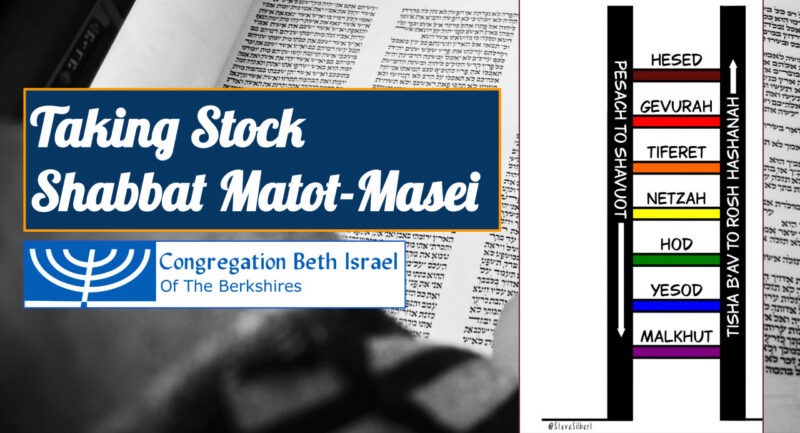
Also in this week’s parsha there’s a recounting of the 42 stops along our wilderness journey, the lifetime since we left Mitzrayim, the Narrow Place. Many numbers have mystical significance in Judaism, and 42 is the number of words in Ana B’Khoah, which we sing before L’khah Dodi asking God to untie our tangles. Its seven lines can represent the seven sefirot (spiritual and divine qualities) we cultivate in ourselves each year.
![[Left] The words of Ana B’Khoah. [Center] A ladder showing the Omer and Reverse Omer journeys. [Right] The seven sefirot / divine qualities we cultivate.](https://cbiberkshires.com/wp-content/uploads/2026/07/42-Stops.png)
And there are instructions about establishing cities of refuge. In context these are a stopgap to prevent endless cycles of violence: the way to avoid reciprocal slaughter, after unintentionally killing someone, was to go to a designated city of refuge where the survivors could not pursue “a life for a life.” This was meant to keep the accidental killer safe through the trial. Which is not, I realize, how our modern justice system works!
But all three of these subjects all say something to me about pausing to take stock. The verses about vows remind me to watch my mouth (literally). Am I living up to my words? The verses about a life’s itinerary remind me to notice where I’ve been. And the verses about refuge remind me to pay attention to my own anger, and to where I habitually turn for safety and consolation… or for distraction from things I don’t want to feel.
And as always, this parsha arrives right on time. We’re in the Three Weeks, the Jewish period of semi-mourning leading up to Tisha b’Av when we remember our community’s losses, starting with the broken tablets of the covenant and going all the way through the destruction of both Temples, the Inquisition, the expulsion from the Warsaw Ghetto, and more. Rosh Hashanah is exactly nine weeks from tonight.
Torah has come to remind us that it’s time to pause and take stock. And here is where I admit that I don’t want to. I don’t want to sit with what’s broken; I don’t want to turn a keen eye on my choices; I don’t want to feel my anger at injustices both large and small; I don’t want to interrogate my habits or my distractions or how I avoid feeling some things; I just want to enjoy summertime and let things be easy. I think most of us do.
Fortunately for me, I’m about to go on rabbinic retreat with the Clergy Leadership Program of the Institute for Jewish Spirituality: four days of tech-free silence, meditation, and time to sit with what is and face all my inner excuses! Just like last year. I know that time of spiritual practice, hevreschaft (friendship), and silence will be a refuge, even if part of me feels a surface-level reluctance to sit with the tough stuff.
And I know that the season is calling us into exactly this. Tisha b’Av is our springboard into seven weeks of the Reverse Omer, which Reb Zalman also called Sefirat haBinyan – “The Counting of the Building.” Just as we look inward during the Omer journey from Pesach to Shavuot, and cultivate seven qualities within ourselves over those seven spring weeks, we’re about to begin again at the opposite end of the ladder.
At this season we begin at the “bottom” of the ladder, with malkhut – presence. Which is fitting as Tisha b’Av invites us into Presence with us and within us, “exiled” in creation, weeping for our broken world and our shattered Temple and our cracked-open hearts. All the things we don’t want to feel: they’re not getting in the way of our teshuvah, our returning. They are the first step in our teshuvah. They are where we begin.
What are we preparing to build? To be clear, not another Temple, at least not one made of stone. (There are Jews who do seek that, but the Reform movement doesn’t and never has.) Reb Zalman once said the “Third Temple” will be “the planet sanctified and healed,” which I love. I mean, that’s what tikkun olam literally means: healing the world. Our building work is spiritual and metaphysical, not tangible.
Every year on Tisha b’Av we face the desolation of the home we built for God. The Temple was shattered by the Roman Empire: an opportunity for us to ask, what forces function like that in the world today? And yet our sages teach the Temple was shattered because of sinat hinam, “senseless hatred” between / among Jews. Do we see that in today’s world too? An opportunity for reflection, noticing habits, beginning to change.
We face what’s broken in our world, in our communities, in our body politic, in the climate, in our own hearts and souls — not for the sake of wallowing, but for the sake of spiritual honesty as we prepare to build anew. We’ll build a new chance to do right by each other and by our world. As our sages teach: “it is not incumbent on us to finish the task, but neither are we free to refrain from beginning.” (Pirkei Avot 2:16)
This is the d’varling that Rabbi Rachel offered at Kabbalat Shabbat services.
The illustration of the ladder of the seven “lower” sefirot is by Steve Silbert; stay tuned for more about the Reverse Omer soon.