A while ago I went looking for a New Yorker cartoon. I don’t subscribe to the magazine these days – I used to, maybe ten years ago, but they arrived more quickly than I could read them. After a while the stack of un-read issues made me feel like I was falling down on the job of being a well-informed poet! Still, many of the illustrations are available online, so I went hunting. I knew exactly what the cartoon looked like. And I couldn’t find it. No one else could seem to find it, either. Maybe it didn’t exist.
Eventually I asked my friend Steve Silbert, an Agile coach who is also an artist and is one of my colleagues at Bayit, to draw it for me. Here’s what I asked for.
I mean, just look back at the last five years. First there was the global pandemic. Then – who could forget the sight of Confederate flags in the Capitol? The end of Roe v. Wade. Wildfires raging around the world. (Apparently some of the ones in northern Canada may not actually go out?) Floods of Biblical proportions, like the ones this year in Texas and in Kentucky, alongside the gutting of FEMA. The horrors of the attack on October 7th. The ensuing devastation, and starvation, of Gaza. Antisemitism rising – and also being used as a pretext for an attempt to quash academic freedom. The return of measles. A rise in white supremacy and white nationalism – including a sitting U.S. Senator declaring recently that America is not “for everyone,” it’s a white Christian homeland. I could go on. (I suspect many of us could.)
How do we live amidst all of this, in this now, without hiding from the world around us and also without succumbing to despair?
That’s the question I kept hearing from y’all this year.
How do we live in this now? How can we face what’s happening all around us – and within us? How can we keep our hearts soft and open when the world around us is so hard? How can we sustain any kind of hope as the planet burns, and democracy wobbles, and the world order we’ve known since World War II seems to be shifting, and divisions over Gaza are tearing the Jewish community apart?
I can’t promise that I’m going to answer all of these questions for us in the next ten days. But I am going to offer the best answers I know how to find in Jewish tradition.
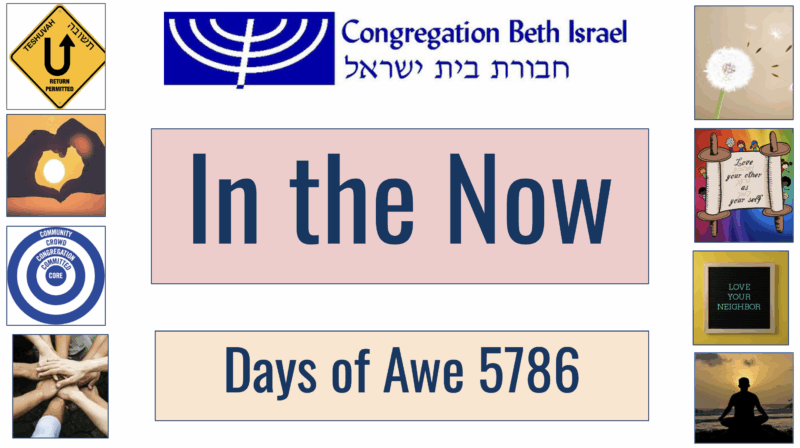
This year’s high holiday theme is In The Now.
 It’s easy to get caught up in remembering what was or anticipating what might be, but we live in the now – right now, this moment, this breath. How can we cultivate hope, in this now? What does it mean to be part of community, in this now? What spiritual practices can help us not only survive, but even thrive, in this now? These are the questions I’ll be addressing in my three sermons over the coming days.
At Rosh Hashanah, the birthday of the world, we focus outward. Tradition teaches that Rosh Hashanah is the anniversary of creation itself; what better time to think about our place in the wide world? This is the day when my words usually touch on world affairs, and on our teshuvah journey with others and with the world. Tomorrow morning I’ll talk about Israel and Gaza, and famine, and what we owe to others and to each other, and where I find hope for the Mideast in this now.
At Yom Kippur we focus inward: on our inner lives, and our mortality, and our teshuvah journey with that One we name as God. Over the course of that day we’ll progressively tighten our focus: first from the world to our community, and then from community to our own individual hearts and souls. At Kol Nidre I’ll talk about community and what spiritual community asks of us – and can offer us – in this now. And on Yom Kippur morning I’ll talk about what I learned on a semi-silent retreat this summer, and three spiritual practices I think can help us not only survive but even thrive in this now.
I love how the bookends of these two holidays teach us to balance outward action and inner change. It makes me think of one of my favorite poems by Mary Oliver:
5am in the Pinewoods
I’d seen
their hoofprints in the deep
needles and knew
they ended the long night
under the pines, walking
like two mute
and beautiful women toward
the deeper woods, so I
got up in the dark and
went there. They came
slowly down the hill
and looked at me sitting under
the blue trees, shyly
they stepped
closer and stared
from under their thick lashes and even
nibbled some damp
tassels of weeds. This
is not a poem about a dream,
though it could be.This is a poem about the world
that is ours, or could be.
Finally
one of them—I swear it!—
would have come to my arms.
But the other
stamped sharp hoof in the
pine needles like
the tap of sanity,
and they went off together through
the trees. When I woke
I was alone,
I was thinking:
so this is how you swim inward,
so this is how you flow outward,
so this is how you pray.Mary Oliver

Together we’ll flow outward and look at our obligations to our world in this now… and together we’ll swim inward and delve into our relationship with self and Source and mortality in this now.
We learn in Talmud (Mishna Yoma 8) that when we miss the mark in relationship with God, Yom Kippur atones. But if we transgress against other human beings or against the world, Yom Kippur will not atone for us until and unless we do teshuvah – recognize our missteps, do the inner work to change, apologize, and then choose differently next time.
 In other words: these holidays aren’t a magical Get Out of Jail Free or wipe-the-slate-clean card.
If we’ve acted wrongly – or if we’ve wrongly failed to act – we need to wrestle with that. We need to do the work of facing our habits and our blind spots. We need to do the work it takes to change. That’s what this season is for. And it makes sense to me that we begin by making teshuvah in an outward sense. We look first at our relationships with each other, and with “the other,” and with the world. We have to make amends to each other and to the world before we turn inward to make amends with ourselves and our Source.
Is this work solemn, sometimes? Might it ask us to face painful truths? Yes and yes. It’s also joyful. It can feel like shedding a burden we hadn’t realized we were carrying. Teshuvah is the work we are here to do in the world. We are always called to notice who we are and how we are, to notice when we fall short or miss the mark, and to try to be better tomorrow than we were today. We forget, and then we remember. We screw up, and then we do our best to repair. We fall down, and then we get up again. We try to make things right with each other. We try to make things right with ourselves.
One of the questions y’all have posed to me is: is this year categorically different from any other? It’s easy to say “the Jewish people have lived through tough times before,” but – is now different? Because of Gaza, because of antisemitism, because of the global rise of “strongmen,” maybe because of all of these taken together?
My simple answer is: I don’t know. I don’t think anyone does. I think in a century or two, historians will look back at our “now” and make sense of it in ways we can’t see from here. We’re like dots in a pointillist painting: we don’t have the distance to see clearly.
Whether or not now is unique in the annals of human or Jewish history, I think our work as human beings and as Jews does not change. We are called to live and to love, to care for our earth and for each other, to protect the vulnerable and love the stranger, to pursue justice and cultivate empathy. And we’re called to do the perennial teshuvah work that supports us in these endeavors, both inside and out.
We may not be living in “precedented times,” but the centrality of this work doesn’t change. I look forward to delving into that with y’all over these ten sacred days.
L’shanah tovah tikatevu v’techatemu: may we all be inscribed and sealed for a good and sweet new year.
This is the d’varling that Rabbi Rachel offered at Erev Rosh Hashanah services on Monday, September 22, 2025.