This is the hardest sermon I have ever tried to write.
My fear this morning is that when I say something that’s hard to hear, you might stop listening or close your heart to what I’m trying to say.
So here is my ask of you this morning. Take a deep breath. Let it out. Maybe do it again a few times. And please make a conscious effort to hold certainties lightly and to keep your heart open.
I hope you will hear me with the trust we’ve built up over the years. And If any of you want to talk about this sermon and what it brings up for you, make an appointment after the holidays are over. I am here to listen to you with love and care. I hope you will listen to me the same way.
In addition to the double bass, which is his primary instrument, my son picked up cello this summer. One evening he asked me to go print him some sheet music. When I came back downstairs with music in my hand, he was playing “Hatikvah.” My eyes filled with tears. Hatikvah is the Israeli national anthem, and its name means “The Hope.”
And I thought: what does it mean to me this year, in this now, to live in hope for Israel and Palestine? How do we live in hope, and how do we live our values in a way that helps to make our hopes real?
Hope asks us to open our eyes. We can’t build a better world without being clear about what already is. And… hope asks us to see beyond what is, into what could be.
This morning’s Torah reading contains the first seeds of conflict between Isaac and his half-brother Ishmael, understood in Jewish and Islamic traditions to be the ancestor of the Arab peoples and/or the ancestor of the prophet Muhammad. We heard Sarah say, “That woman’s child will not share an inheritance with my son.” Hagar and Ishmael are cast out with a piece of bread and a container of water. When the food and water are gone, Hagar places her son under a bush, not wanting to watch him die.
I feel for Sarah, who feared her son’s half-brother as a source of danger. I feel for Abraham, who was troubled but did what he thought God was telling him to do. I feel for Ishmael and Isaac, who were just children. And I feel for Hagar, who couldn’t bear to watch her son’s life ebb away. Torah doesn’t tell us how many days they might have wandered in the wilderness before she put him down in a patch of shade. I imagine an emaciated child, weak from malnutrition, lips cracked with thirst.
Reading these words this year, how can we not think of children in Gaza?
Some of us may be feeling relief: oh, good, she mentioned Gaza. Some of us may be feeling resistance: ugh, why did she mention Gaza? Some of us may be feeling anxiety about where this sermon is going to go, so here’s the roadmap: I’m going to talk about responsibility to those who are starving, and about what Torah says we can ask of each other, and about where I find hope.
I’ll start with this small reason for hope: from my colleagues across the Reform movement to dozens of prominent Orthodox rabbis who recently called out and condemned the famine in Gaza, Jewish leaders are starting to say clearly that people in Gaza are starving and we must feed them.
Some of us may be thinking: “but Rabbi, no country in the world would allow an October 7th to happen to its people and not retaliate. Israel is held to an impossible standard that no other nation is asked to meet.” Or maybe we’re thinking, “Criticizing Israel gives ammunition or comfort to people who want to wipe us out.”
I hear you. I see that stuff online too. One morning while I was working on this sermon, I saw a university professor saying Israel should be wiped off the map, and the first commenter saying Israelis should be afraid for their lives wherever they go. It’s painful and it’s activating and it breaks my heart. And I’m not going to let it stop me from speaking about our obligation as Jews to face starvation and destruction in Gaza.
On the “impossible standard” front, I used to have this argument with my mother, of blessed memory. She pointed out that I didn’t seem to feel agita in the same way if any other nation did something that troubled me. And she used to say to me, “it’s not fair to hold Israel to a different standard than everyone else; that’s antisemitic.”
Here is what I now wish I had thought to say to my mom: yes, people do hold Israel to standards by which no other nation is judged, and that’s unfair. But when we as Jews want Israel to act ethically?
That’s not antisemitism: it’s a call for teshuvah – for turning toward God* (*or turning toward our deepest values and highest aspirations), and trying to be better.
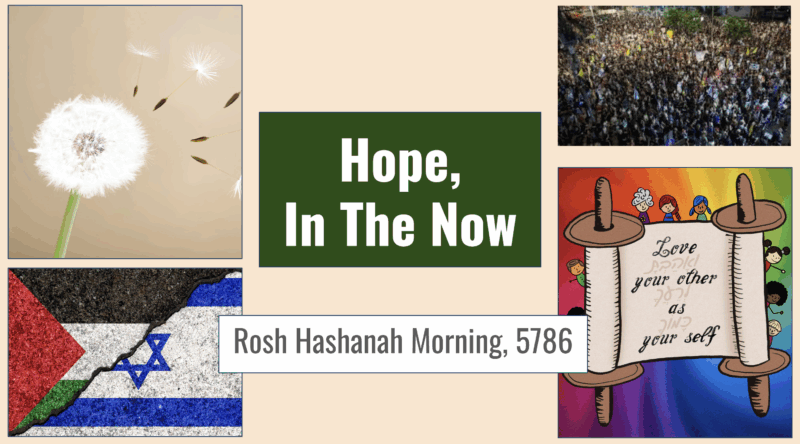
A lot of Israelis are calling their nation to teshuvah. Starting in January of 2023, first tens of thousands and eventually hundreds of thousands of Israelis demonstrated every week in protest of the Netanyahu administration’s plans to take over the judiciary.
Those protests stopped on October 7, because most Jewish Israelis’ attention turned to Kibbutz Be’eri, Kfar Aza, Netiv Ha’asara, the Nova music festival, and the hostages. But soon the weekly protests started up again, now calling for diplomacy rather than war.
In late August, more than two million Israelis stood out in Tel Aviv to protest the actions of their government and call for an end to the fighting and the starvation in Gaza. That’s twenty percent of the population standing up for change. One of my friends there notes that people at the protests have different reasons for participating. Some are focused on the hostages, others on the humanitarian tragedy in Gaza and the need to end the famine. All big movements are coalitions, and people don’t all participate for the same reasons. But as she puts it, “I don’t care if people are calling to a stop for the ‘right’ or ‘wrong’ reason, as long as it ends up stopping.”
I find hope in those protests, just as I find hope in those who are calling our own country to live up to its highest ideals. That’s a whole other sermon, though I will note that Jewish values ask us to care for the vulnerable, to welcome the stranger, and to uplift human diversity as a reflection of the Divine.
Political scientists Erica Chenoweth and Maria Stephan found – after analyzing a century of history – that if 3.5% of a population participates in sustained, nonviolent protest, they can change a nation’s course. Can you imagine what would happen if not merely 3.5%, but 20%, of Americans stood up for these values?
Hope asks us to look at what is, and then imagine what could be. Here is what is: in recent months the Netanyahu administration has allowed very little food to enter the Gaza Strip. What has been allowed in has been brought in a way that doesn’t reach everyone. Children, the sick, the elderly, and people weakened by hunger cannot reach the four food distribution centers currently operating in lieu of the 400 that the UN operated before. Of those who do make it to those food distribution stations, hundreds (maybe as many as 1400) were shot by soldiers this summer while trying to access food. All of this was true even before the ground invasion began last week.
In the words of Israeli journalist Orit Kamir, “there is no electricity, no gas, no clean water; if someone finds a potato peel – there isn’t even a way to cook it.” Kamir compares this to her mother’s memories of starving in the Lvov ghetto. And she notes that because this sounds too terrible to be true, many of us assume it can’t be true.
The destruction and famine in Gaza are dire, Israel’s government bears responsibility, and many of us feel responsibility too.
To be clear: Hamas is also responsible for this reality. I blame Hamas for every choice they have made and every bit of harm they have caused. I hope the world will continue to call them out and demand that they do better. And I think it is our job, as part of the global Jewish community, to offer this loving tokheha (critique) and ask ethical behavior of our fellow Jews.
R. Brent Spodek teaches that part of what defines a relationship is the ability to make an “ask.” If we’re friends or family, if we have a relationship between us, then we have the right to ask things of each other. I ask my son to bring his dishes to the dishwasher. I ask my friends to listen when I need to talk. I ask my fellow Jews to join me in trying to live up to Jewish values. Those values are my dream of what could be.
On Yom Kippur afternoon we will read a series of instructions for ethical life, the verses at the literal and metaphorical heart of the Torah. One of them is the commandment not to hate our kin in our hearts, and not to hold back critique when it needs to be offered, lest our silence encourage wrong behavior. Notice how those two are linked. First Torah commands us not to hate, even when people mess up badly. Then Torah commands us to speak to our kin and help them shape up.
The corollary is that we have to be willing to receive critique, too. I am sitting with the critique I have received for not speaking out against the destruction of Gaza sooner. I will need to figure out how to try to make teshuvah for that.
The passage culminates with the injunction to love the other as we love ourselves. This our tradition calls klal gadol ba-Torah, “the great principle of Torah.” Torah says it’s our obligation to call our kin into living up to Judaism’s highest ideals. It is our obligation to do this with love. And it’s our obligation to do this as part of a larger program of loving the other, because all are made in God’s image.
Rabbi Shai Held teaches (in his book Judaism Is About Love) that this core mitzvah has nothing to do with being loved. It doesn’t matter whether the “other” loves us. (I mean, it might matter to us, but from a Torah perspective it’s irrelevant.) The mitzvah is to love, period.
We are commanded to love God* (*whatever that word means to us – God far above, God deep within, the still small voice, the force of love or creativity or hope), we are commanded to love each other, and we are commanded to love “the other,” the stranger. Calling for immediate food aid for Gaza, along with Israelis who are doing the same, is an act of love – and an act of hope toward a different future.
I find hope in protests across Israel. I find hope in my friends and colleagues there who demand humanitarian aid for Gaza, who stand with and stand up for Palestinians in the West Bank when they are harassed or attacked, who insist that neither people is going anywhere and that safety and coexistence are possible.
I find hope in the existence of Standing Together, Jews and Palestinians building a coalition of partnership on the land they all call home. I find hope in A Land for All, a joint movement of Israelis and Palestinians that “envisions two democratic, sovereign states linked together in a confederation” – I don’t know whether their plan will work, but I find hope in their insistence that creative solutions must be found (or made).
I find hope in Jumpstarting Hope in Gaza, a coalition of more than a dozen Israeli NGOs bringing water, sanitation, hygiene, and energy to the people of Gaza. I find hope in the New Israel Fund’s campaign to address hunger and other needs in Gaza. NIF doesn’t ordinarily fund humanitarian aid, nor support causes outside of Israel. But this time the need is so great and the moral obligation is so clear. As they write on their website, simply, “Helping is the right thing to do.”
And I find hope in my friends and colleagues there who are brave enough to name their fears that as their government destroys Gaza, it may also be destroying the ethical and spiritual core of their own nation.
I also take to heart this wisdom from my colleague R. Ruhi Sophia Motzkin Rubenstein, who notes that because current realities are so terrible, there are many Palestinians and many Israelis who right now can’t envision a future of coexistence.
In her words, “those of us who are not living under those daily traumas must hold that vision of coexistence on everyone’s behalf. And to work for it, we must start from our own complicity as Americans, and our own failures up to this point.”
My friend and teacher Rabbi Abby Stein noted this summer that it can feel hard, even impossible, “to see a light at the end of the horrific newscycles.” It’s easy to feel overwhelmed by how much is broken in our world. But she cites a teaching from her ancestor, Rabbi Avraham Yehoshua Heschel of Apta, reminding us that in a dark room it only takes a small candle to bring light. “The most broken of times provide us with an opportunity to create the greatest of times.”
Our Torah reading for today didn’t end with Hagar placing her son under a bush to die. An angel calls out to her, asking, “What’s with you, Hagar? Don’t fear: God has heard the cry of the boy from where he is.” She opens her eyes to see a miraculous spring of water, and they are saved.
I believe that God still hears the cries of the starving… and I believe that in today’s world we are God’s hands. Feeding the hungry is our responsibility, and that includes those who are starving in Gaza. (I donate to Jews for Food Aid for Gaza.) It’s aleinu / “on us” to feed the hungry; to shelter the homeless; to speak up for justice, liberty, and peace. To offer loving critique even of our fellow Jews, and to receive loving critique when we fall down. To love our neighbor, our “other,” as we love ourselves.
And it’s on us to resist despair. Despair whispers that nothing will ever be better than it is now. Hope, in the words of Ruth Ben-Ghiat, “keeps alive the idea that another reality is possible in the future and that our daily actions… can make a difference.”
I’ll close today with words from poet Vaclav Havel, the last president of Czechoslovakia, which I found via author Rebecca Solnit. Havel writes:
Hope is a state of mind, not a state of the world. Either we have hope within us or we don’t; it is a dimension of the soul; it’s not essentially dependent on some particular observation… Hope is not prognostication. It is an orientation of the spirit, an orientation of the heart; it transcends the world that is immediately experienced, and is anchored somewhere beyond its horizons. Hope, in this deep and powerful sense, is not the same as joy that things are going well… but, rather, an ability to work for something because it is good.
Hope is a state of mind, a state of heart, anchored somewhere beyond the world we know – I would say, anchored in God*. For Havel, hope is the ability to work toward something better than what is. May we work toward better, both in the Middle East and here at home. And in that merit, may we be blessed for a good and sweet new year.
This is the d’varling that Rabbi Rachel offered at Rosh Hashanah I services on Tuesday, September 23, 2025.