In this week’s Torah portion, Hayyei Sarah, Avraham sends his servant Eliezer to find a wife for Isaac. And Eliezer says, God, help me out: could You make it so that whichever woman offers to help me get water not only for myself but also for my camels, that woman is the one You’ve intended for my master’s son? Rebecca waters all of the camels, and offers Eliezer lodging, and she turns out to be a member of Avraham’s family which in the Biblical paradigm was a good thing, and when Eliezer asks if she’ll come and marry Isaac she says yes on the spot.
So then they travel together to meet Isaac, and when Rebecca first sees him, he is לָשׂוּחַ בַּשָּׂדֶה לִפְנוֹת עָרֶב, “walking in the fields at the approach of evening.” I don’t want to spoil what we’ll be learning tomorrow morning in SoulSpa, so I’ll just mention that there is a lot of really cool, deep, rich stuff around that moment and I can’t wait to dive into it with y’all (join us on Zoom!) Anyway, this evening I want to linger on the phrase לִפְנוֹת עָרֶב / at the cusp of evening. At the face of twilight. At the time when day is mixing itself with night.

The Hebrew word for evening, ערב, comes from a root that means intermixing. It’s not “day,” it’s not “night,” it’s the in-between. It’s a threshold in time, a transition. A time of changing light. There’s a piece of art by Dov Abramson that I really love – I have a print of it in my living room. It’s called שעות זמניות / “hours of time” or “relative hours.” The color blocks represent the colors of the sky at different times, and each is marked with a Mishnaic phrase for marking time: not this or that o’clock, but things like dawn, midnight, “the time when the stars come out.”
Because we live in a modern world ruled by modern notions of time, things at shul happen at A Given Time. Right now Shabbat services happen at seven o’clock, even though these days sundown is considerably earlier, and in high summer it’s considerably later. (We’re thinking about changing that in the coming months – maybe doing one monthly at 5:30 and one at 7, to accommodate different community needs – but that also won’t actually be aligned with the sun.) In Jewish time, Shabbat begins and ends not at any o’clock but when the sky looks a certain way.
I love how organic that is. When we pay attention to the changing sky, a summer Shabbat can have an entirely different feel than a winter one. I’m not actually proposing that we schedule our services at a different hour every week, following the changing length of days! But I am suggesting that we could make a practice of pausing to notice the changing light. I particularly love watching the sky and the light change at the horizon, the place where the hills meet the sky. I have taken an endless number of photographs of the changing color of the sky over the hills.
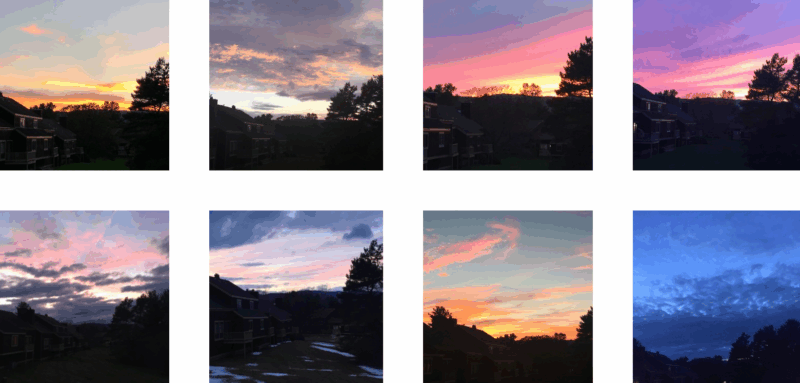
The other morning I was driving my son to an early bus to an audition as the sun was rising over the hills. As we bumped along Blair Road with his double bass, he observed how beautiful the hills and the sky are – “even when it looks like it does now.” Even in “stick season,” this unlovely time of year between autumn’s splendor and winter’s sparkle. In that moment, I thought: if I’ve managed to teach him to pay attention to the hills and the sky, to seek and to see the beauty in our surroundings even on a drab November day, I have given him one of the best gifts I have.
Pausing to notice the sky and the hills can be both an encounter with constancy and an encounter with change. The hills and the sky are always there. They are forever, or as close to forever as my human mind can imagine. And the hills and the sky are always different – both are always changing. In the words of Richard Bach, “even though it’s changing every second, the sky is always a perfect sky.” לָשׂוּחַ בַּשָּׂדֶה לִפְנוֹת עָרֶב, “walking in the fields at the cusp of evening,” is a practice of noticing the perfection in what’s always changing – and also noticing what never changes.
Last week I encountered a poem by Rosemary Wahtola Trommer called “Placing attention:”
As the weather is changing
and the light is changing
and the birds at the feeder
in the yard are changing,
as the leaders are changing
and the feelings are changing
and the way that we see
each other is changing,
I notice the invitation to turn
toward the truth
of what does not change—
something so vast, so unnamable,
so unable to be grasped and held,
something so present
there is no life without it,
that knows itself
through you, through me,
through clover and tree and cloud
and goes on and on and on forever.
That. I turn again and again
toward that.
Our world is always changing. The sky is always changing. We are always changing. And that change is balanced with what never changes. What Trommer calls, “Something so vast, so unnamable,” that “goes on and on and on forever.” One of our tradition’s names for that is “God.” We could also call it Justice, or Love. (Those are names of God in our tradition too.) Our lives may sometimes feel short and ephemeral like a moment of changing sky. And our souls are part of something infinite, the flow of being that always was and always will be.
I invite you to join me in pausing to notice what changes and what doesn’t change. Walking in nature is one way to do that. Another way is through walking in the fields of sacred text, experiencing the balance of constancy and change that is Torah study. I heard from one of you earlier this week that the phrase “Torah study” makes you imagine an angry rabbi putting you on the spot to answer questions, like a nun ready to rap your knuckles with a ruler if you get something wrong. And I thought: oh, wow, I really want to give you a different vision!
When I talk about Torah study, I mean something more like: drawing in wisdom, and dreaming into what might yet be. Tradition teaches us to read “written Torah” along with “oral Torah,” which means that the written Torah is only the beginning of the story. In one understanding when Torah was given at Sinai, what flowed in that moment (and flows even now) was Torah (which is ancient), and Midrash (less ancient), and Talmud (less ancient still), all the way up through the new words and understandings we haven’t yet evolved enough to uncover.
Reb Zalman z”l taught that the revelation of Torah at Sinai was like an infinitely compressed download of all of the Jewish wisdom that ever was and ever will be. Our job is discovering what Torah needs to be for us today, as we listen inside ourselves for the flow of insight that is still resounding. Torah is a living document. Turn it like a kaleidoscope, see something new. In SoulSpa we’re exploring Torah alongside midrash, stories that explore and explain, and alongside what my chaplaincy supervisor used to call “the lived Torah of human experience.”
Our sages teach that Torah is written in “black fire on white fire,” the “black fire” of received tradition and the “white fire” of midrash. Studying Torah means looking back at inherited tradition, and looking forward into new ideas that have never before been spoken. When we engage in Torah learning together, the interplay of our souls and our minds brings the text to life in a new way. Join us on Zoom (10am Saturdays) as we immerse in the flow of Jewish wisdom forever unfolding and expanding, as simultaneously constant and changing as the hills and the sky.
This is the d’varling that Rabbi Rachel offered at Kabbalat Shabbat services.