On the first day of the second month, in the second year after the exodus from the land of Mitzrayim, YHVH spoke to Moshe in the wilderness of Sinai, in the Tent of Meeting, saying: Take a census of the whole Israelite community by the clans of its ancestral houses, listing the names, every male, head by head. You and Aharon shall record them by their groups, from the age of twenty years up, all those in Israel who are able to bear arms. (Numbers 1:1-3)
That’s how the Book of Numbers begins. This is the action from which the whole book takes its English name: Numbers, because we are numbering our people, or more specifically numbering the men aged twenty and up who are able to fight. In Hebrew, this book of Torah is called Bamidbar, “In the Wilderness” – the location where it takes place; the location, considered “ownerless,” where we are blessed to receive Torah.
I’ve been studying this parsha for months with one of our teenagers who became bat mitzvah last weekend, and I can tell you that the first thing she noticed was that this census does not count any women. Or anyone who is nonbinary, or under the age of 20, or ill, or for some other reason unable to fight. This census is about counting “able-bodied men,” and that is not synonymous with “our whole community.”
This is not a radical observation, but it bears repetition. I am so grateful to live in, and to serve, an egalitarian Jewish community where people of all genders are valued. We count ten adult Jews in a minyan. This is a low bar for inclusivity, but I’m glad we soar over it. I also believe, and hope, that we are a community that values neurodiversity and knows we all “count” even when we process or experience the world in different ways.
I’ve been thinking a lot about why we always read Bamidbar, this story of this census, right before Shavuot when we receive revelation anew. The tradition holds that 600,000 souls stood at Sinai to receive Torah, and that in some deep, mystical soul way each of us was there. And several of our sages draw a connection between receiving Torah as a whole community, and the fact that a Torah is only kosher if every letter is present.
(We’ll look at some of those teachings tomorrow morning at SoulSpa – join us at 10am!)
I love the idea that we are like a Torah, requiring every letter in order to be whole. And… the census count in Torah is only a count of fighting-capable men. That can’t be the measure of community. Fortunately tradition also teaches that Torah is written in black fire on white fire, and that both are holy. For me that offers the beginnings of an answer and the beginnings of a kind of healing. (We’ll explore this more deeply tomorrow too.)
R. Avi Weiss, a contemporary American modern Orthodox rabbi, writes:
Black fire refers to the letters of Torah… [and] white refers to the spaces between the letters… On another level, the black fire represents the p’shat, the literal meaning…The white fire, however, represents ideas that go beyond the p’shat… This is called d’rash – interpretations, applications, and teachings that flow from Torah… The black letters are limited, limiting and fixed. The white spaces catapult us into the realm of the limitless and the ever-changing, ever-growing. They are the story, the song, the silence.
Just as a Torah requires every letter and every space in order to be kosher, so the Jewish people requires all of us. Just as the written Torah is completed and made whole by the presence of the oral Torah, so our community is completed and made whole when all of us count, across all of our differences and diversities. This sounds simple, maybe pat. But I think it is a critical teaching about being (in) community.
And one of the most difficult places to value one another is across our different perspectives on Israel and Palestine. As the last few years have shown, we may carry whole different sets of facts in mind and heart. I’m not talking about prejudice or propaganda, but about how multiple things can be true at the same time. (And we’re increasingly unable to hear each other: see R. Jay Michaelson’s latest, When It Comes to Israel/Palestine…)
Nick Kristof’s piece this week is a Rorshach test. In response I have heard, “Abuse of Palestinians is unconscionable.” “How could Israelis do or condone that?” “Of course that doesn’t happen.” “The sources he cited are biased against us.” “The world is biased against us.” “The accusation is blood libel.” “How could anyone take this story seriously?” “How could anyone fail to take this story seriously?” It’s so easy to become defensive.
I want us to lift up shared values: rape is wrong, may all victims find healing. I want us to hold competing truths: some people hate Jews / Israel and want to believe the worst of us, and also our tradition calls us always into heshbon ha-nefesh / an “accounting of the soul” / examining our own possible abuse of power. I want us to practice dan l’khaf z’khut, giving one another the benefit of the doubt when we disagree.
All of our souls were at Sinai. In order to be a whole community, we need to feel-with one another. It takes strength, courage, and humility to stand together to receive Torah even when we know we don’t all see Israel and Palestine the same way.
Our sages teach that the Jewish people is like a Torah, and that if any letter is erased the whole of who we are is fundamentally incomplete. If that is true, and I believe it is, then it’s a virtue to be in community across disagreement. And even when we disagree we can and should still learn from and with each other — value each other — and treat each other with grace. We can still cultivate curiosity and compassion for each other.
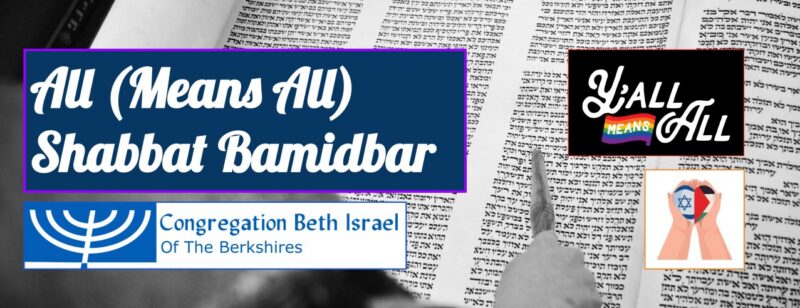
There’s a t-shirt I used to see in Texas, usually written in the rainbow colors that evoke queer pride and diversity, that reads, “Y’all means all.” I see in that slogan an insistence that we all belong. That our differences make us a beautiful patchwork that wouldn’t be complete without every single square – a tapestry that needs every splendid thread. That’s how I understand Jewish community. That’s what Sinai invites us into.
The census in our parsha was important. It was also incomplete, because it only included a subset of men, and we can (and must) do better now. May our Judaism be one in which every one of us counts – in which our whole selves are welcomed – in which we make a practice of uplifting and loving each other even when we disagree. Imagine the revelation we can receive if we can stand together with this in our hearts.
This is the d’varling that Rabbi Rachel offered at Kabbalat Shabbat services.