Guest Post: “Reclaiming Our Lives with Radical Rest”
This guest post is by cantorial soloist and CBI member Ziva Larson, who led Kabbalat Shabbat services on Friday, March 13, 2026.
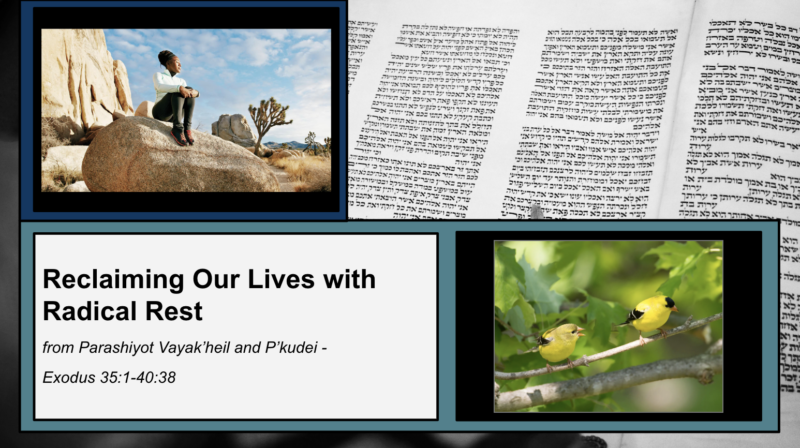
In this week’s Torah portion, Moses convenes the whole Israelite community and shares with them several commandments given by God. The very first commandment is: “On six days work may be done, but on the seventh day you shall have a sabbath of complete rest, holy to Adonai; whoever does any work on it shall be put to death” (Jewish Publication Society, 2023, Exodus 35:2). I don’t know about you, but to me, this sounds pretty extreme. If you do any work on the day of rest, you will be put to death? Is there another way to make sense of this statement? How might this be relevant and meaningful in our lives today?
The dominant culture in the United States today is one of capitalism and consumerism, of overwork and exploitation. Productivity and “having or doing it all” are touted as morally superior goals and aspirations. Compliance to an unrealistic pace and expectations and to rigid routines, such as those found in the workplace and in schools, is expected and normalized. Failure to adhere to these routines and expectations, regardless of one’s own needs, health, or capacity at any given time, often has serious consequences. These consequences include, but are not limited to, disciplinary action and loss of a job – which can result in a loss of income, loss of health insurance, food insecurity, loss of housing, and more. People are treated as expendable “human resources” rather than as precious human beings. Adhering – or attempting to adhere – to the unreasonable and unrealistic pace and expectations demanded by the systems of capitalism, white supremacy, and the patriarchy profoundly harms people’s health and wellbeing and significantly increases the risk of premature death (Every, 2026).
Returning to our Torah portion, perhaps this is what is meant by “[…] whoever does any work on [Shabbat / their day of rest] shall be put to death” (Jewish Publication Society, 2023, Exodus 35:2). If we do not prioritize rest, our health and wellbeing suffer, and our risk of premature death increases. Additionally, if we do not prioritize rest, if we are always working and always striving to “be productive” at the expense of just being, just existing, then we are never truly living. In essence, we have already died.
In her book Rest is Resistance: A Manifesto, writer, multidisciplinary artist, activist, theologian, self-proclaimed daydreamer, and founder of The Nap Ministry Tricia Hersey challenges the violent, oppressive, and exploitative systems of capitalism, white supremacy, and the patriarchy by framing rest as an act of radical resistance and reclaiming our power and humanity (Hersey, 2022a). Instead of thinking about rest as laziness, unproductiveness, wasting time, and so on, we can think about rest as taking back our time as well as our minds and bodies from systems that exploit and harm us. Indeed, in the book Laziness Does Not Exist, social psychologist Dr. Devon Price argues that so-called “laziness” is actually a normal, healthy, and wise response to exhaustion, burnout, a lack of support, or values misaligned with our lives (Price, 2021). It is not a personal failing (Price, 2021). The concepts of laziness, unproductiveness, and wasting time are all constructs of capitalism and white supremacy. Therefore, rest, as a direct challenge to these capitalistic and white supremacist constructs, is an act of radical resistance.
Naturally, the first thing that might come to mind when I say “rest” is “sleep.” However, rest is so much more than sleep. Rest can take many different forms for different people and at different times. For example, it can include napping, exercising, reading, spending time with friends and loved ones, participating in meaningful rituals, such as a Shabbat practice, taking a break from technology, spending time outside, daydreaming, and so on – really anything that feels good and restorative to you. Rest can be anything that rejuvenates you and fills your cup and restores your sense of self and sense of wholeness, or sh’leimut (שְׁלֵמוּת) (which comes from the same root as the Hebrew word shalom (שָׁלוֹם)). Or, as Tricia Hersey puts it, “Rest is anything that connects your mind and body” (Hersey, 2022b).
Rest can have a profound, positive impact on our lives. And, as our Torah portion this week suggests, Shabbat is a weekly reminder and opportunity to rest.
I’d like to end with a poem by Mary Oliver that, I believe, beautifully illustrates the importance of rest. It is titled “Invitation” (Oliver, 2017).
Oh do you have time
to linger
for just a little while
out of your busy
and very important day
for the goldfinches
that have gathered
in a field of thistles
for a musical battle,
to see who can sing
the highest note,
or the lowest,
or the most expressive of mirth,
or the most tender?
Their strong, blunt beaks
drink the air
as they strive
melodiously
not for your sake
and not for mine
and not for the sake of winning
but for sheer delight and gratitude—
believe us, they say,
it is a serious thing
just to be alive
on this fresh morning
in this broken world.
I beg of you,
do not walk by
without pausing
to attend to this
rather ridiculous performance.
It could mean something.
It could mean everything.
It could be what Rilke meant, when he wrote:
You must change your life.
May we be inspired to take time out of our busy schedules to listen to the birds.
May we have the strength and courage to resist violent, oppressive, and exploitative systems and change our lives by actively choosing to rest and take care of ourselves, today and every day.
And may our radical rest restore a sense of self and a sense of wholeness, of sh’leimut (שְׁלֵמוּת), to each and every one of us.
Shabbat Shalom.
References
- Every, E. (2026, February 12). When working too much turns deadly. Think Global Health. https://www.thinkglobalhealth.org/article/when-working-too-much-becomes-deadly
- Hersey, T. (2022a). Rest is resistance: A manifesto. Little, Brown Spark.
- Hersey, T. (2022b, February 21). Rest is anything that connects your mind and body. The Nap Ministry. https://thenapministry.wordpress.com/2022/02/21/rest-is-anything-that-connects-your-mind-and-body/
- Jewish Publication Society (2023). The JPS Tanakh: Gender-sensitive edition.
- https://www.sefaria.org/Exodus.35?lang=bi&aliyot=0
- Oliver, M. (2017). Invitation. In Devotions: The selected poems of Mary Oliver (pp. 107-108). Penguin Press.
- Price, D. (2021). Laziness does not exist. Atria Books.